
The BabaTap Pool is the organized network of eligible service providers available for consideration when a senior customer or family member submits a booking request through BabaTap. It brings together two distinct types of providers: BabaTap Pros, who participate as individual service providers, and BabaTap Partners, which are home care businesses or senior support organizations participating as companies. Although these two provider types operate differently, they can be included within one coordinated pool so that BabaTap’s AI Matching system has a broader and more diverse group of potential providers to evaluate.
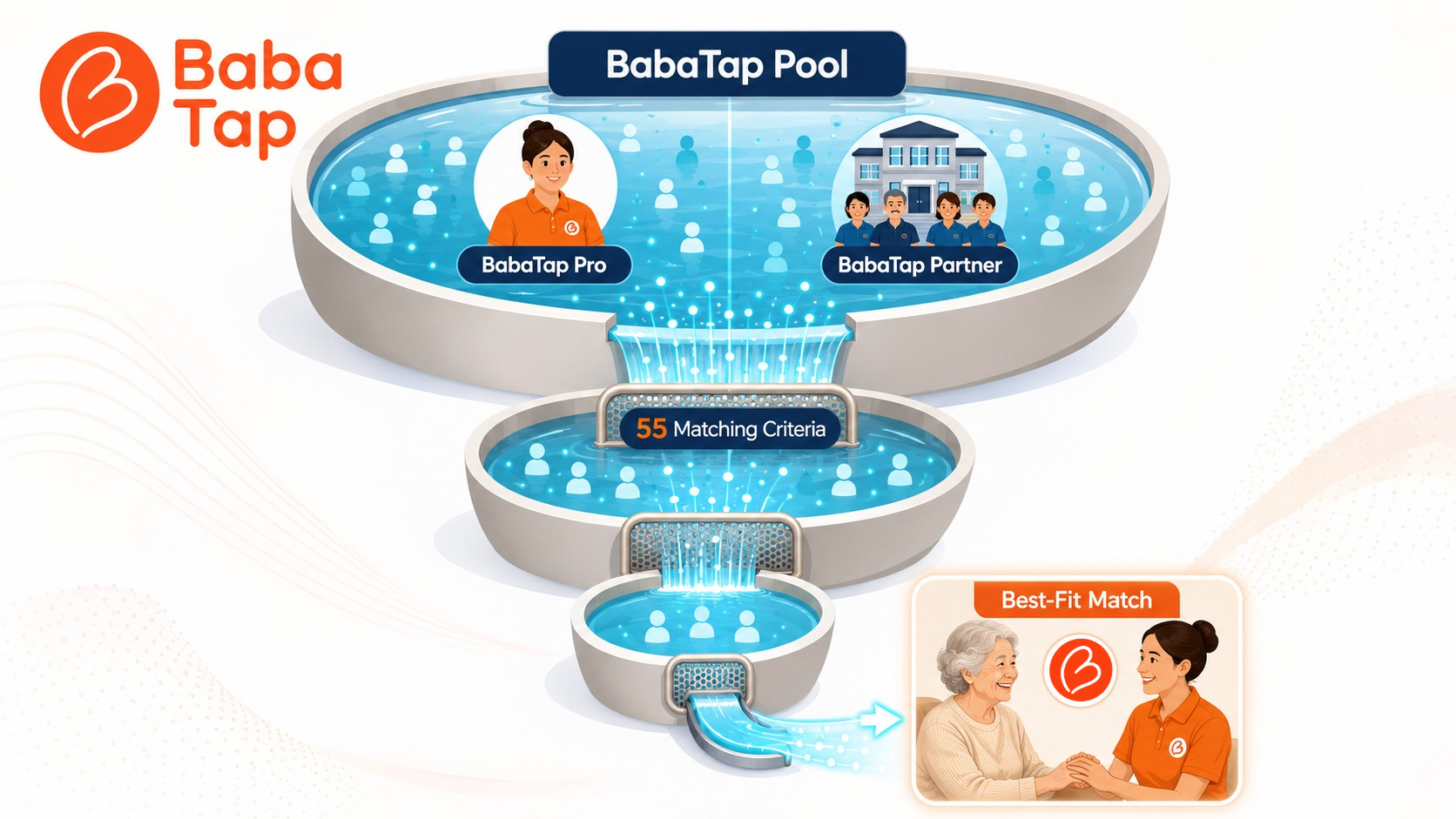
A BabaTap Pro is an individual who applies to provide approved non-medical senior support services personally. Depending on the individual’s qualifications, experience, availability, transportation access, service area, and approved profile, a BabaTap Pro may offer companionship, grocery shopping and errands, technology help, meal preparation, hospital companionship, check-in visits, walking support, pet care, light home support, or senior transportation.
A BabaTap Partner is a participating home care business or senior support company. Instead of one individual personally accepting and completing every booking, a BabaTap Partner may receive a suitable booking opportunity and assign an appropriate member of its team. The company remains responsible for confirming that the assigned worker is available, properly screened, adequately trained, qualified for the requested service, and covered by the organization’s operating requirements and insurance.
The BabaTap Pool does not mean that every registered provider will automatically receive every booking request. It is better understood as the qualified source from which suitable candidates may be identified. When a booking enters the system, BabaTap does not need to send it randomly to everyone. The platform can first compare the booking requirements with the information associated with eligible BabaTap Pros and BabaTap Partners. Providers who do not meet essential requirements can be excluded, while those who appear more suitable can be evaluated more closely.
This structure is especially important in senior support because two bookings that appear similar on the surface may require very different provider capabilities. Two customers may both request companionship, but one may need a bilingual provider, while the other may need someone comfortable supporting a person living with memory challenges. Two customers may both request transportation, but one may only require a simple ride, while the other may need door-to-door assistance, space for a folded wheelchair, help entering a medical facility, and a driver willing to wait during the appointment.
A traditional matching process based only on city and service category may overlook these differences. BabaTap’s goal is to build a more informed matching system that considers a wider range of relevant factors. The AI Matching framework is designed to evaluate provider and booking information across 55 criteria. These criteria can reflect several dimensions of suitability, including service compatibility, location, travel distance, scheduling, provider availability, customer preferences, language support, mobility considerations, experience, qualifications, reliability, operational capacity, and previous service performance.
The 55 criteria do not all need to carry the same importance for every booking. Some may operate as essential conditions. If a provider does not serve the customer’s city, does not offer the requested service, or is unavailable at the requested time, that provider may not be suitable regardless of other strengths. Other criteria may help distinguish between several candidates who have already passed the essential requirements. For example, a closer provider with relevant experience and a strong history of responding reliably may be ranked above another provider who technically qualifies but is located farther away.
This is why the size and quality of the BabaTap Pool matter. AI Matching cannot create qualified providers where none exist. If a city has only one provider in the Pool, the system has very little choice. It can determine whether that provider meets the basic requirements, but it cannot meaningfully compare several possible matches. If that provider is unavailable, lives too far away, does not offer the requested service, or cannot accommodate a customer’s specific needs, the booking may remain unmatched.
When the Pool contains more qualified BabaTap Pros and BabaTap Partners, the matching system has more realistic alternatives to consider. One provider may be located closer to the customer. Another may speak the customer’s preferred language. A third may have more experience with hospital companionship. A BabaTap Partner may have several staff members and greater scheduling capacity. An individual BabaTap Pro may offer stronger continuity because the customer can receive support from the same person over time. A larger Pool gives the system the ability to compare these differences instead of relying on the first available name.
However, the purpose is not simply to accumulate the largest possible number of records. A large collection of incomplete, outdated, unverified, or inactive profiles would not necessarily improve matching. In some cases, poor-quality information could make the results less reliable. BabaTap therefore needs both network growth and data quality. Provider information should be accurate, relevant, regularly updated, and connected to actual service capacity.
For BabaTap Pros, useful matching information may include their approved services, primary city, nearby service areas, maximum travel distance, languages, availability, transportation access, experience, training status, qualifications, and service history. For BabaTap Partners, the system may also need information about the company’s operating area, staff capacity, dispatch process, preferred booking notice, business hours, insurance status, worker-screening practices, training procedures, and ability to assign a suitable person.
Availability is one of the most important examples of why data quality matters. A provider may generally be available on weekday afternoons, but that does not guarantee availability for a particular Tuesday at 2:00 p.m. An individual may already have another confirmed booking. A company may be open but have no suitable employee available for that service. AI Matching can use stated availability as an initial signal, but the provider must still confirm actual availability before the booking becomes final.
Geographic information is equally important. Listing a provider as serving an entire city may not be precise enough when travel time varies significantly between neighbourhoods. A provider located near the customer may be able to respond more reliably and incur fewer travel-related costs. Another provider may be willing to travel farther but require more notice. A home care company may serve several surrounding communities through different staff members. Accurate location and service-radius information helps the system identify practical matches rather than merely theoretical ones.
The presence of both BabaTap Pros and BabaTap Partners makes the Pool more flexible. Individual providers can bring personal experience, community familiarity, specialized skills, language abilities, and continuity. Many seniors value seeing the same familiar person for recurring services. An individual BabaTap Pro may build a strong relationship with a customer and understand that person’s routine, preferences, and communication style.
BabaTap Partners can add organizational capacity. A company may have several screened workers, wider operating hours, internal scheduling support, or the ability to arrange a replacement if the originally assigned person becomes unavailable. This can be valuable for bookings requiring greater capacity, recurring coverage, multiple service times, or support across a wider geographic area.
Neither provider type is automatically better for every booking. The purpose of the BabaTap Pool is to make both available for appropriate consideration. AI Matching can evaluate the characteristics of the request and determine which candidates appear most compatible. A recurring weekly companionship request may be well suited to an individual BabaTap Pro who can provide continuity. A booking requiring rapid coverage during a busy period may be more suitable for a BabaTap Partner with several available staff members. The outcome should be guided by the needs of the customer rather than by a fixed preference for individuals or companies.
The 55 criteria give the matching process a more complete framework, but the number itself should not be misunderstood as a guarantee of perfection. AI can organize information, compare many variables, apply eligibility rules, identify conflicts, and rank potential candidates more consistently than a simple manual search. It can reduce the time required to review a large Pool and help BabaTap avoid overlooking important details. Nevertheless, the result still depends on the accuracy of the information provided by customers and providers.
AI Matching should therefore be understood as decision support rather than a replacement for human responsibility. A high matching score does not automatically confirm a booking. The provider must review the request, verify availability, assess whether the service falls within the approved scope, and accept the booking. BabaTap may also need to review unusual requests or clarify important details with the customer. The final confirmation occurs only after the relevant parties have verified that the service can be completed appropriately.
This human confirmation is especially important when serving older adults. A booking form may not capture every practical detail. A customer may mention limited mobility without explaining whether stairs are involved. A family member may request hospital companionship without specifying whether the provider must meet the senior at home or at the hospital. A transportation request may not initially state that a walker must be stored in the vehicle. AI can identify the need for clarification, but responsible communication remains essential.
The BabaTap Pool can also support better backup matching. Service disruptions sometimes occur even after a booking has been accepted. A provider may become ill, experience a vehicle problem, or face another unexpected situation. If the Pool contains several qualified alternatives in the same area, BabaTap has a better chance of identifying a replacement. When only one provider exists, a cancellation may leave the customer with no practical option.
A larger Pool also improves coverage across different times. Senior support is not limited to standard office hours. Some customers need early transportation to medical appointments, evening assistance after hospital discharge, weekend companionship, or support on short notice. Individual providers may offer flexible hours, while participating companies may provide broader scheduling coverage. Combining both types increases the possibility of finding a provider whose actual availability corresponds with the request.
Language and cultural compatibility may also affect customer comfort. A senior who has difficulty communicating in English may feel more secure with a provider who speaks a familiar language. Some customers may have preferences related to communication style, food preparation, personal space, or family involvement. These factors should be handled respectfully and only when relevant to the service. A broader Pool increases the likelihood that the system can find someone who meets both practical and communication needs.
Matching quality can improve further as BabaTap develops reliable service history. With appropriate safeguards, the system may consider whether a provider responds promptly, accepts suitable bookings, arrives as scheduled, completes services correctly, communicates professionally, receives positive feedback, and avoids repeated cancellations. These signals can help distinguish between a profile that appears suitable and a provider who has demonstrated reliability through actual service delivery.
Data must be used responsibly. BabaTap should collect information that supports legitimate service matching, operational safety, quality, and customer communication. The purpose of the 55 criteria is not to gather unnecessary personal information or make intrusive judgments. Criteria should relate to the provider’s ability to perform the requested service and the customer’s stated needs. Sensitive information should be protected, access should be limited appropriately, and matching logic should avoid unlawful or unfair discrimination.
Transparency is also important. Customers do not necessarily need to see every calculation performed by the system, but they should understand that a match considers factors such as service, area, availability, and relevant needs. Providers should know that keeping their profiles accurate can affect which booking opportunities they receive. They should also have a reasonable way to update availability, service areas, qualifications, and operating capacity.
The BabaTap Pool becomes more valuable when participants actively maintain their information. A BabaTap Pro who moves to another city should update the service area. A provider who temporarily stops offering transportation should change the profile. A BabaTap Partner that expands into a new community should record the new coverage only when it truly has staff available there. Accurate updates help AI Matching avoid wasting time on candidates who cannot actually perform the service.
Network diversity is another advantage of growth. If all providers offer the same service during the same hours in the same neighbourhoods, increasing the number of profiles may not substantially improve coverage. BabaTap benefits most when the Pool includes varied service abilities, languages, schedules, travel ranges, experience levels, and organizational capacities. The goal is not only more providers but more meaningful choices.
This distinction explains why BabaTap is inviting home care businesses to participate as BabaTap Partners while continuing to develop its community of BabaTap Pros. Companies can help fill geographic or scheduling gaps that individual providers cannot always cover. Individual providers can offer local flexibility and personal continuity that may not be available through every organization. Together, they create a more balanced Pool.
For home care businesses, participation creates an additional channel for receiving suitable booking opportunities in the cities they choose to serve. The company can specify its services and coverage rather than being expected to accept every request. When a potential match is identified, the Partner reviews the booking and decides whether it has a suitable worker. The business remains responsible for the person it assigns and for compliance with its legal, insurance, privacy, training, and operational obligations.
For individual BabaTap Pros, the expanded Pool does not mean that companies will automatically replace them. Matching should be based on suitability. An individual with the right location, availability, skills, language, and service history may be the strongest candidate for a particular customer. The addition of BabaTap Partners strengthens overall capacity and provides alternatives when an individual is unavailable or when a business structure is more appropriate.
For customers, the benefit is a better opportunity to receive a workable match. A larger and more complete Pool can reduce the number of situations in which BabaTap identifies no provider at all. It can support faster searches, better geographic coverage, more scheduling options, stronger backup capacity, and closer alignment with special requirements. These improvements can make the booking experience more dependable for seniors and their families.
The BabaTap Pool also creates a foundation for continuous improvement. When the system records which matches are accepted, declined, completed, rescheduled, or cancelled, BabaTap can study patterns and refine its matching approach. If providers frequently decline requests beyond a certain travel distance, distance weighting can be improved. If some services require longer notice, the system can account for that. If a Partner has strong capacity on weekends but limited weekday availability, future recommendations can reflect the pattern.
Such improvements should be made carefully. Historical data may contain gaps or reflect temporary conditions. A provider should not be permanently disadvantaged because of one legitimate cancellation or a short period of unavailability. Matching should consider current information, allow profiles to be corrected, and maintain human oversight. The objective is to improve practical outcomes, not to create an inflexible automated judgment system.
The 55 criteria provide structure, while the BabaTap Pool provides choice. Both are necessary. Criteria without a sufficiently large Pool may produce an accurate conclusion that no suitable provider is available. A large Pool without meaningful criteria may produce too many unorganized choices and increase the risk of unsuitable assignments. When network growth and structured matching develop together, BabaTap can deliver more relevant recommendations.
This approach reflects BabaTap’s broader vision of using technology to strengthen human support. AI Matching does not perform companionship, drive a senior to an appointment, prepare a meal, provide reassurance in a hospital, or help someone use a phone. Those services are provided by people. The role of technology is to help connect the right customer with an appropriate person or organization more efficiently.
BabaTap’s success will therefore depend on more than the sophistication of its matching system. It will depend on the quality of BabaTap Pros, the reliability of BabaTap Partners, the accuracy of customer requests, responsible use of data, clear service standards, and effective communication before, during, and after each booking. AI can help coordinate these elements, but trust is created through real service experiences.
As BabaTap expands into more cities, the Pool can reflect the unique characteristics of each local market. A major metropolitan area may require neighbourhood-level matching because travel times vary widely. A smaller city may need providers willing to cover surrounding communities. Some areas may have many home care companies, while others may depend more heavily on qualified individuals. The BabaTap Pool allows the network to adapt without relying on a single service model.
Ultimately, the BabaTap Pool is not simply a database of names. It is the operational foundation that brings together approved individuals and participating businesses, organizes their relevant capabilities, and makes them available for structured matching. Its value grows when the network becomes larger, more diverse, better verified, and more accurately maintained.
By expanding the number of BabaTap Pros and BabaTap Partners, BabaTap gives AI Matching more genuine options to compare across its 55 criteria. More suitable candidates can mean better alignment with location, service, schedule, language, experience, mobility needs, capacity, and customer preferences. It can also create stronger backup options and reduce the likelihood that a customer’s request remains unmatched.
The goal is not to claim that technology can always identify a perfect provider. The goal is to make each matching decision more informed, consistent, and responsive than it would be with limited choices or a simple city-based search. Through a growing BabaTap Pool, structured evaluation across 55 criteria, and final confirmation by people, BabaTap can build a more dependable way for seniors and families to find local non-medical support.
As more qualified individuals and responsible home care businesses join the network, BabaTap can continue improving its ability to connect customers with providers in the cities they serve. This combination of community participation, organizational capacity, accurate data, and thoughtful AI Matching supports BabaTap’s central purpose: helping seniors access respectful, practical services that strengthen independence, confidence, safety, and connection in everyday life.
BabaTap
Bài viết liên quan: