
As the workforce changes, employers are increasingly recognizing that supporting employees means understanding the responsibilities they carry outside the workplace as well as the responsibilities they have at work. Many employees are simultaneously professionals, parents, spouses, and caregivers for aging parents or other loved ones. A family member may need transportation to a medical appointment, assistance with grocery shopping, companionship at home, help with everyday errands, support surrounding a hospital visit, or personal care services that are difficult to access outside the home. When these needs arise during working hours, employees are often left trying to coordinate care while managing meetings, deadlines, customers, and other professional responsibilities.
BabaTap Family Care Benefit™ is designed to give employers a practical way to support employees facing these everyday family care challenges. Instead of expecting every employee to independently find, coordinate, and pay for support, an employer can establish a BabaTap Family Care Benefit™ program that helps cover eligible services for employees and their families. Depending on the benefit arrangement selected by the employer, services may be fully sponsored by the organization or partially sponsored, with the employee responsible only for the remaining portion of the service cost.
The concept is straightforward. The employee or family member uses the service, while the employer provides some or all of the financial support through the benefit program. This means that a service does not become free simply because the employee pays nothing at the time of booking. The service still has a defined value and cost, but the employer has chosen to cover that cost as part of its employee benefits strategy. In other arrangements, the employer may cover a percentage or provide a defined annual care allowance, while the employee pays any amount that is not covered.
This approach can make services across the BabaTap ecosystem more accessible to employees and their families. Depending on eligibility, location, program design, and service availability, employees may be able to access everyday support through BabaTap, senior transportation through RideSenior, and mobile personal care services through TapLook. Instead of treating these as completely separate family challenges, BabaTap Family Care Benefit™ is designed to bring them together within a broader family care benefit framework.
For an employer, the objective is not simply to purchase individual appointments for employees. The larger opportunity is to establish a structured benefit that employees know is available when they or someone they care about needs practical support. For employees, the benefit can provide another resource for managing responsibilities that might otherwise require time away from work, extensive care coordination, or significant out-of-pocket expenses.
How Employers Can Offer BabaTap Family Care Benefit™
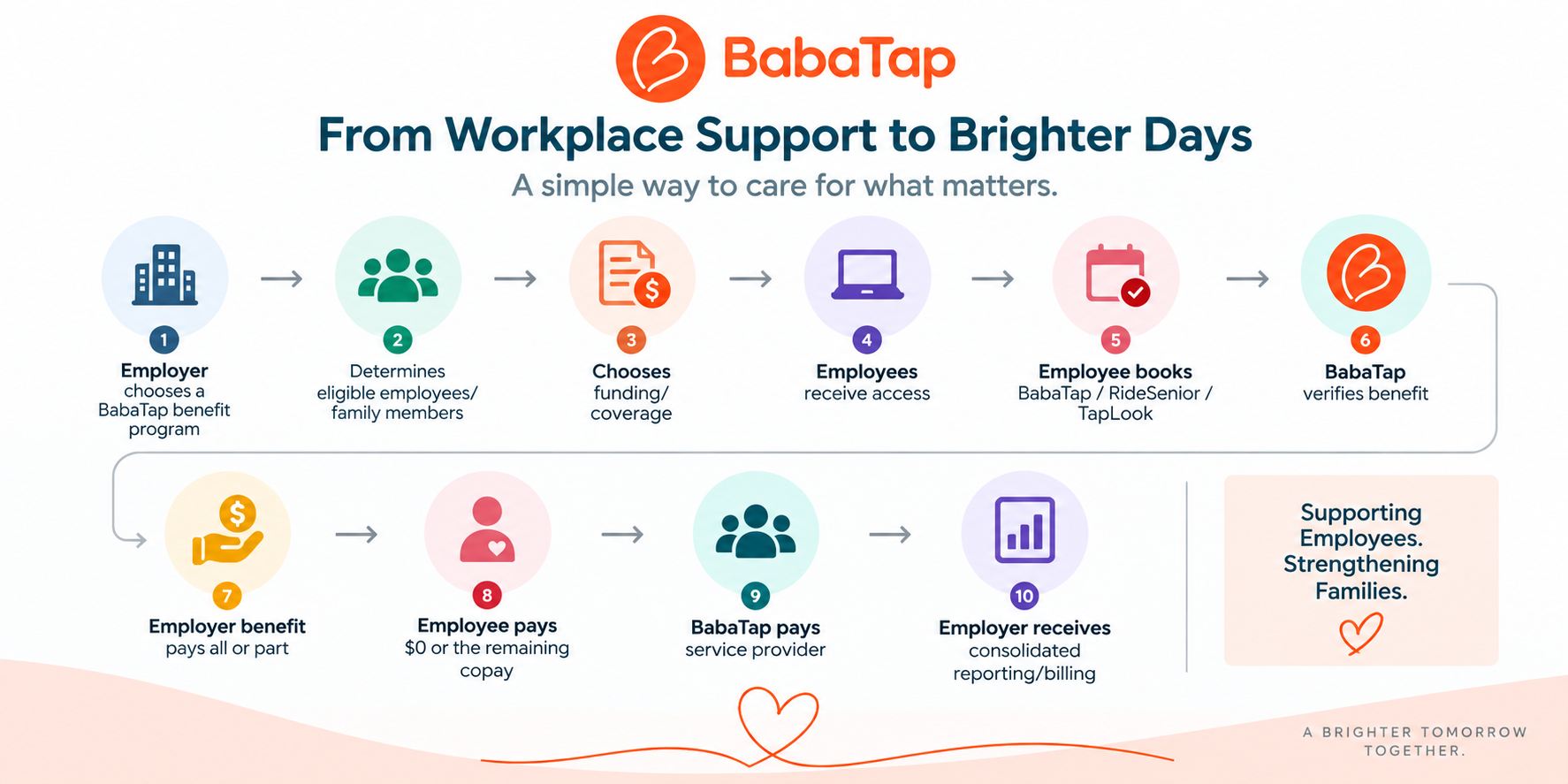
The process begins with an employer deciding that family care support is something it wants to make available to its workforce. An organization can contact BabaTap to discuss the number of employees it would like to cover, the locations in which those employees and their eligible family members may require services, the types of support it wants to include, and the amount of financial coverage it wants to provide. Because every workforce is different, BabaTap Family Care Benefit™ can be structured around the objectives and budget of the participating employer rather than requiring every company to use exactly the same benefit design.
One employer may be primarily interested in helping employees who care for aging parents. Another may want to create a broader family support program. A company with employees concentrated in one city may require a different structure from an organization with employees distributed across multiple provinces, states, or regions. The benefit design can therefore begin with understanding who will be eligible, where services are required, which categories of support will be included, and how much of the cost the employer intends to sponsor.
A central decision is the employer’s funding model. One company may decide to fully sponsor eligible services up to an annual limit. For example, an employer could provide each eligible employee with a defined amount of BabaTap Family Care Benefit™ credit every year. When the employee uses an eligible service, the cost is deducted from the available benefit balance. As long as sufficient benefit credit remains and the service meets the program’s eligibility requirements, the employee may have no out-of-pocket payment for that booking.
Another employer may prefer partial sponsorship. Under this structure, the organization could cover a defined percentage of each eligible service while the employee pays the remaining portion. If an eligible service costs $100 and the employer’s program covers 80 percent, for example, the employer-funded benefit would cover $80 and the employee would be responsible for the remaining $20. This approach allows an employer to make family care significantly more affordable while maintaining a predictable benefit structure.
Employers may also choose to establish annual or periodic care allowances. A company might provide an employee with a specific amount of family care credit for the benefit year and allow the employee to decide when that support is most valuable. One employee might use most of the available benefit for transportation for an aging parent, while another might use it for companionship, errands, hospital support, or a combination of services. The employer establishes the benefit parameters, while the employee receives flexibility within the eligible service categories.
A customized program may also establish different coverage levels for different services. An employer could decide that certain transportation or hospital-related services receive one level of coverage while other everyday support services receive another. Eligibility, limits, employee contributions, covered family relationships, geographic availability, and other program rules can be established as part of the agreement between BabaTap and the participating organization.
Once the program structure has been determined, BabaTap and the employer can establish eligibility. Depending on the program, eligibility could include all employees or a defined employee group. The benefit may also specify whether services can be used by the employee personally, by an eligible parent or aging loved one, or by other eligible family members. This is particularly important because one of the core purposes of BabaTap Family Care Benefit™ is to recognize that the person who needs support may not be the employee.
Consider an employee who works full-time in Edmonton while an aging parent lives elsewhere in the same city. The employee may be perfectly healthy and never personally require BabaTap services. The employee’s mother, however, may need help with groceries, transportation, companionship, or personal care. Under an employer-sponsored family care benefit, the employee may be able to use available benefits to arrange support for the parent. The value to the employee comes from knowing that help can be arranged for someone they care about without having to personally handle every task.
The same principle becomes even more important for families separated by distance. An employee may work in Calgary while a parent lives in Toronto, or an employee may live in one region while coordinating support for a family member in another participating service area. Where service availability and the employer’s program rules allow, the benefit can help the employee coordinate support even when the employee cannot physically be present.
After eligibility and funding rules are established, participating employees can receive access to the BabaTap Family Care Benefit™ program. As the platform develops, this experience may include benefit eligibility information, available care balances or credits, eligible service categories, family profiles, booking capabilities, and information showing how much of a service is covered by the employer. The goal is to make the financial arrangement understandable before the employee completes an eligible booking.
Behind the benefit is the broader BabaTap service ecosystem. BabaTap focuses on practical everyday non-medical support that may include companionship, grocery shopping and errands, meal preparation, light home support, technology assistance, hospital companionship, pet care, and other eligible services based on location and availability. RideSenior provides senior-friendly transportation services that can support medical appointments, hospital discharge transportation, and other transportation needs. TapLook provides mobile personal care services that may include haircuts, manicures, pedicures, and other available personal care services delivered at homes, hospitals, retirement communities, assisted living settings, or other eligible locations.
This connected approach is important because family caregiving rarely involves only one type of need. An aging parent may need transportation today, grocery assistance next week, and personal care services later in the month. Instead of asking the employer to establish unrelated arrangements for every category, BabaTap Family Care Benefit™ can provide a broader framework through which eligible services within the BabaTap ecosystem can be made available.
The employer does not necessarily need to become involved in every individual booking. The benefit program can establish the rules in advance, while BabaTap manages eligible service coordination according to those rules. This is an important distinction because the employer’s role is to provide the benefit, not to manage an employee’s family life. The employee should be able to use the benefit within the established program parameters without requiring a manager to manually approve every ordinary care request unless the employer’s particular program specifically requires such approval.
Employers can also receive program-level information appropriate to the benefit arrangement. Over time, this may include information such as overall utilization, eligible populations, benefit usage, service categories, aggregate program activity, and other reporting designed to help an organization understand how its family care benefit is being used. The intention is to provide organizations with useful program administration information while respecting the personal nature of individual family care situations and applying appropriate privacy practices.
The employer relationship can therefore be understood as more than simply purchasing services at a discounted rate. The company is creating a family care funding mechanism for its workforce. Employees gain access to practical support, while BabaTap provides the infrastructure connecting benefit eligibility, funding, booking, service delivery, and the appropriate service network.
For employers evaluating whether to introduce the program, the potential value extends beyond the individual transaction. Family caregiving responsibilities can appear unexpectedly and often cannot simply be postponed until after work. A parent may be discharged from a hospital in the afternoon. A transportation arrangement may fall through. An aging family member may need groceries or help with an essential task. An employee may suddenly find themselves trying to solve the problem from their desk. By providing access to family care resources, employers can give employees another option before the only solution becomes leaving work or attempting to coordinate everything alone.
BabaTap Family Care Benefit™ is therefore intended to complement an employer’s existing benefits strategy rather than replace medical insurance, disability benefits, employee assistance programs, professional home care, or other established benefits. Its focus is the practical everyday support gap that can exist around those programs. The program can become an additional layer of support for employees whose families need real-world assistance with everyday activities.
How Employees Use It
For employees, the experience should be much simpler than the benefit administration happening behind the scenes. Once an employer has established BabaTap Family Care Benefit™ and an employee is eligible, the employee can access the program and determine what benefit coverage is available. The employee may have a care credit balance, a defined employer contribution, a percentage of eligible services covered, or another arrangement established by the employer.
The employee can then identify who needs the service. In many cases, that person may be an aging parent rather than the employee. The employee can provide the necessary recipient information, location, requested service, preferred date and time, and other details needed to coordinate the booking. The system can then determine whether the requested service is eligible under the employer’s benefit program and how much financial coverage is available.
Suppose an employee’s mother needs transportation to a medical appointment and RideSenior is an eligible service under the employer’s program. The employee can arrange the ride through the applicable BabaTap benefit experience. If the employer covers the full eligible cost and sufficient benefit funds remain, the employee may pay $0 for the covered portion. If the employer covers only part of the service, the benefit can be applied first and the employee pays the remaining balance.
The same employee might later need someone to spend time with the parent, assist with groceries, help with errands, or provide another eligible everyday support service. In that case, BabaTap may be the appropriate service network. On another occasion, the parent may find it difficult to travel to a salon for a haircut or personal care appointment. If TapLook services are included in that employer’s program, the employee may be able to apply available family care benefits toward an eligible mobile personal care booking.
This is where the broader BabaTap ecosystem becomes especially useful. The employee does not necessarily need to think in terms of three separate companies. From the employee’s perspective, the question is much simpler: what does my family need today, and is that support covered by my benefit? The appropriate service can then be coordinated through BabaTap, RideSenior, or TapLook according to the nature of the request, geographic availability, program eligibility, and other applicable requirements.
An employee could therefore use the same family care benefit at different moments for different needs. During one month, the most important issue might be transportation. During another, it might be companionship or grocery assistance. At another time, personal care at home might be more valuable. This flexibility recognizes that caregiving needs change and that families are often better positioned than employers to determine which eligible services are most useful at a particular moment.
The payment experience is equally important. BabaTap’s objective is for employees to clearly understand what their benefit covers and whether they have any personal financial responsibility. If a service is fully covered within the applicable benefit rules and sufficient funding remains, the employee may have no amount to pay for the eligible portion. If the employer sponsors only part of the cost, the employee can be responsible for the balance. If the employee has exhausted an annual care allowance, the employee may still have the option to purchase additional services directly, depending on the program and service availability.
For example, imagine that an employer provides an employee with $750 in annual BabaTap Family Care Benefit™ credits. The employee uses $120 for an eligible RideSenior service for a parent, later uses $150 for BabaTap support, and then uses $100 toward an eligible TapLook service. The applicable amounts are deducted from the available employer-sponsored benefit rather than requiring the employee to personally absorb the full cost of each service. Once the benefit balance is exhausted, additional services could be handled according to the employer’s plan rules.
Another employer might use a percentage model instead. If the organization covers 70 percent of eligible services throughout the year, an employee booking a $100 eligible service could receive $70 in employer-sponsored coverage and pay $30 personally. The service itself remains worth $100. The BabaTap Family Care Benefit™ simply changes how that $100 is funded.
This distinction is fundamental to the program. BabaTap is not trying to make professional service providers work for free or artificially reduce the value of their work. The goal is to create additional funding pathways so that the person receiving support does not always have to bear the entire cost personally. The employer, health plan, insurer, or participating organization becomes part of the funding structure, making eligible care services more financially accessible to employees and families.
Employees also benefit from having a clearer place to begin when a family need arises. Caregiving can involve significant coordination, particularly for someone dealing with an aging parent for the first time. Families may not know whom to call for transportation, where to find companionship support, or whether someone can provide a personal care service at home. Bringing multiple categories of support into one ecosystem can reduce some of that fragmentation and give employees a more straightforward path to arranging help.
The benefit can be particularly meaningful for employees who cannot easily leave work every time a parent needs assistance. An employee should not have to choose between an important meeting and helping a parent with a routine errand if another appropriate support option is available. Similarly, someone who lives far from a parent may experience considerable stress when a simple task requires physical presence. BabaTap Family Care Benefit™ is intended to help create another option for those situations.
At the same time, the program is not intended to replace family relationships or professional medical and clinical care. BabaTap does not suggest that companionship or practical support can replace the role of family members, physicians, nurses, therapists, emergency services, or regulated care professionals. Instead, the benefit is designed to help with the many everyday tasks that exist between those relationships and services. Families remain involved, but they have additional support when they cannot personally handle every need.
For the employee, perhaps the most important idea is that using BabaTap Family Care Benefit™ should feel like using a benefit provided by the employer rather than asking the employer for a personal favor. If the program covers an eligible parent and the employee has available benefit funding, using that benefit is simply part of the employee’s benefits package. Just as employees may use other workplace benefits when they need them, family care support can become another resource available at the appropriate time.
For employers, this creates an opportunity to provide a benefit employees can experience in very practical terms. Instead of an abstract promise of support, the benefit can help when a parent needs a ride, when a loved one needs someone nearby, when groceries need to be picked up, or when personal care at home would make daily life easier. These are ordinary situations, but for working caregivers they can create significant pressure.
The long-term vision of BabaTap Family Care Benefit™ is therefore simple: make it possible for more people to receive the everyday support they need without requiring the individual or family to carry the entire financial burden alone. Employers can sponsor all or part of the cost, employees can use the benefit for eligible family care needs, and the BabaTap ecosystem can connect those needs with appropriate services through BabaTap, RideSenior, and TapLook.
By bringing employer funding, employee eligibility, family needs, service coordination, and multiple care categories into one benefit ecosystem, BabaTap aims to create a more practical approach to family support. Employees gain another resource for caring for the people who matter to them, employers gain a meaningful way to support their workforce, and families gain greater access to services that can make everyday life easier.
BabaTap Family Care Benefit™ is built around a simple idea: employees should be able to focus on their work without feeling that they have to handle every family care responsibility alone. When someone they love needs a helping hand, their workplace benefit can help make that support possible.
BabaTap
Bài viết liên quan: