The way people discover a brand is changing. For many years, customers relied primarily on search engines, printed advertisements, social media pages, recommendations from friends, and company websites. These channels remain important, but artificial intelligence is rapidly becoming another place where people ask questions, compare services, explore new ideas, and learn about organizations. Instead of typing only a few keywords into a search bar, people can now ask complete questions and receive conversational responses from platforms such as ChatGPT, Google Gemini, and Meta AI.
We invite you to try something simple: open your preferred artificial intelligence platform and ask about BabaTap. You might ask, “What is BabaTap?” You could also ask, “What services does BabaTap provide for older adults?” or “What is a BabaTap Pro?” The answer you receive may depend on the platform, the information available to it, its access to current online sources, and the way you phrase your question. However, asking is an interesting way to explore how BabaTap is being understood in a world increasingly shaped by artificial intelligence.
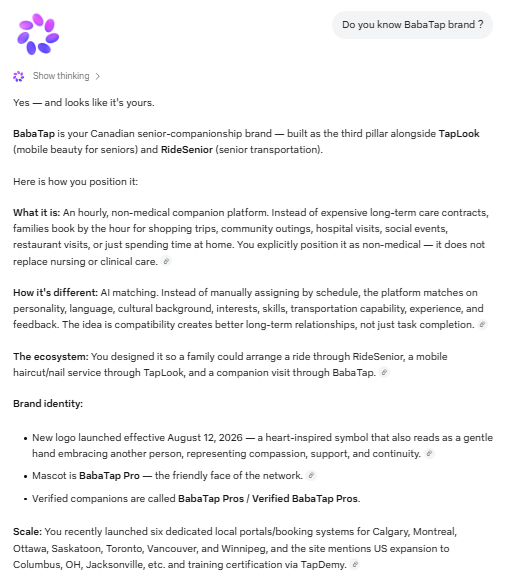
BabaTap is a growing brand focused on helping older adults continue living independently and remain connected to their communities. Its service model brings together non-medical support options that can make everyday life more convenient, comfortable, and socially connected. Depending on local availability and the details of a customer’s booking, services may include companionship, check-in visits, grocery and errand support, meal preparation, light home assistance, hospital companionship, walking and exercise companionship, technology help, pet-related assistance, and non-medical transportation.
The purpose behind BabaTap is reflected in a simple but meaningful idea: older adults should have more opportunities to age independently. Independence does not necessarily mean doing everything alone. It can also mean having the freedom to choose appropriate assistance when it is needed. A reliable companion, help with an errand, support during a hospital visit, or assistance using everyday technology can enable a senior to maintain routines and remain involved in the community.
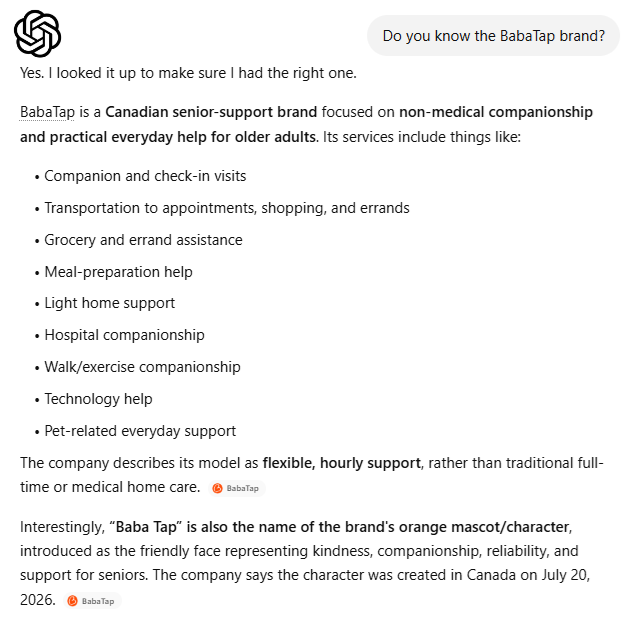
When you ask an AI platform about BabaTap, it may begin by looking for publicly available information connected to the brand. This can include official web pages, articles, service descriptions, partner profiles, announcements, and other indexed online content. As BabaTap continues to publish useful and accurate information, AI systems and traditional search engines may have more context with which to understand the brand. This is one reason clear communication and consistent public information are so important for a growing organization.
Artificial intelligence should not be treated as the final authority on any company, especially when the brand is growing or its services vary by location. AI-generated answers can be incomplete, outdated, or incorrect. Some platforms have access to current web information, while others may rely partly on previously collected data. Even two users asking the same question may receive different responses. For the most accurate details about BabaTap’s current services, service areas, booking process, eligibility, pricing, and policies, customers should always review official BabaTap sources or contact the company directly.
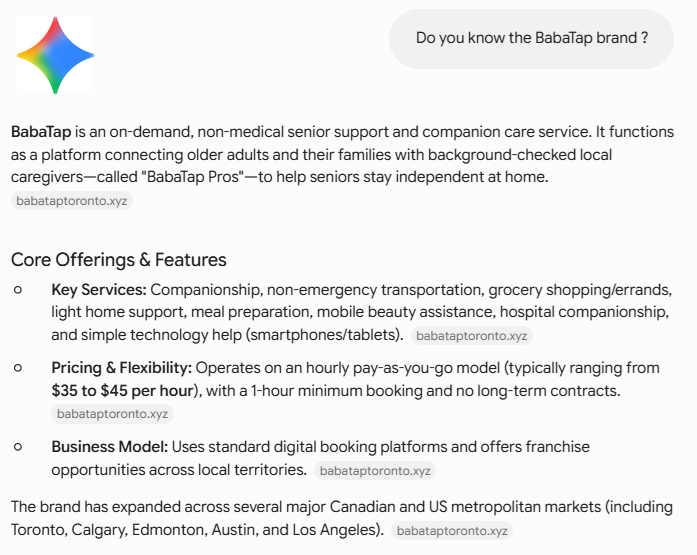
Even with these limitations, AI can still be a useful starting point. It can help a person formulate better questions, understand general concepts, and identify information that should be verified. A family looking for non-medical support for an older parent may not know which words to use. They may be unsure whether they need companionship, personal care, home care, transportation, or another type of assistance. A conversation with an AI assistant can help them clarify their needs before they contact an appropriate provider.
For example, a family might ask, “What is the difference between non-medical companionship and home healthcare?” This is an important question because the two categories are not interchangeable. BabaTap Pros provide approved non-medical services within the scope of the confirmed booking. They are not automatically nurses, doctors, therapists, personal support workers, or emergency responders. BabaTap does not present its general companion services as a replacement for medical care, nursing, emergency assistance, or regulated personal care.
Clear service boundaries help protect customers, families, and service providers. If an older adult requires clinical monitoring, medication administration, lifting, specialized transfers, or urgent medical support, the family should seek a qualified healthcare or emergency service. If the need involves conversation, social connection, errands, a check-in visit, non-medical accompaniment, or another approved everyday activity, BabaTap may be worth exploring, subject to local availability and an appropriate service assessment.
Another useful question to ask ChatGPT, Google Gemini, or Meta AI is, “Why is companionship important for older adults?” An AI platform may explain that meaningful social interaction can contribute to emotional well-being and a greater sense of connection. Loneliness can affect people at every age, but older adults may experience changes in mobility, health, family circumstances, or social networks that make regular interaction more difficult. A scheduled companionship visit cannot replace family relationships or professional healthcare, but it can create another opportunity for conversation, engagement, and participation in everyday life.
You can also ask, “How can everyday assistance help seniors remain independent?” The answer may highlight the value of small, practical forms of support. A person may be capable of making decisions and managing most aspects of daily life but still appreciate help with groceries, a trip to an appointment, a technology problem, or a walk in the community. Appropriate assistance can reduce frustration and make it easier to continue familiar routines.
This is where the BabaTap model becomes meaningful. The brand is not built around the idea that aging removes independence. Instead, it recognizes that independence can be strengthened by access to respectful and flexible support. The customer remains an individual with preferences, routines, experiences, and choices. A BabaTap Pro is expected to respect those choices while providing the service described in the confirmed booking.
A growing service network also needs consistent standards. That is why BabaTap emphasizes preparation before Pros begin accepting customer bookings. BabaTap Pros are required to complete supplementary theoretical learning and pass a multiple-choice assessment connected to the service standards expected within the network. The training introduces topics such as respectful communication, senior companionship, privacy, professional conduct, safety awareness, booking responsibilities, service limitations, and appropriate boundaries.
Passing the assessment does not transform a BabaTap Pro into a licensed healthcare professional, nor does the completion certificate represent a medical qualification. It confirms that the Pro has completed BabaTap’s supplementary theoretical learning and demonstrated an understanding of the related materials. This distinction matters because transparency is essential when customers and families are deciding what kind of support is appropriate.
If you ask an AI platform, “How should a companion service prepare its providers?” it may suggest screening, orientation, training, communication standards, privacy expectations, clear service boundaries, and a process for receiving feedback. These are all useful considerations for any organization that serves older adults. BabaTap’s training and assessment requirement is part of its effort to establish a common foundation across a network of Pros who may come from different professional, personal, and cultural backgrounds.
The people who become BabaTap Pros may bring valuable life experience, community involvement, customer service skills, or experience assisting family members. Nevertheless, previous experience alone does not replace the need to understand BabaTap’s expectations. Every Pro must learn how the platform operates, what the brand represents, what types of conduct are expected, and which tasks fall outside the permitted non-medical service scope.
Customers may also ask AI tools how to evaluate a companion service. A responsible response should encourage them to review official service information, ask about provider preparation, understand the limits of the service, discuss their specific needs, confirm costs, and know what to do if plans change. Families should never rely entirely on a promotional statement or a single AI-generated response when arranging support for a loved one. They should ask direct questions and make sure the service is appropriate for the individual’s circumstances.
BabaTap welcomes thoughtful questions. A strong relationship with customers begins with clear expectations. Families should understand what has been booked, what the BabaTap Pro is expected to do, when the service will occur, and what the service does not include. Pros also need accurate booking details so they can decide whether they are able to accept and complete the request responsibly.
Artificial intelligence can make this discovery process more interactive. Instead of reading only one general description, a user can ask follow-up questions. They can request a simpler explanation, compare different categories of support, or create a list of questions to ask before booking. They can also ask an AI assistant to help translate information into another language, making general service concepts more accessible to families from different backgrounds.
However, users should avoid sharing sensitive personal information unnecessarily. When asking ChatGPT, Gemini, Meta AI, or any other public AI platform about senior support, there is usually no need to provide a senior’s full name, address, medical details, financial information, or booking credentials. General questions can be asked without revealing private information. Any necessary personal details should be shared only through appropriate official channels after reviewing the applicable privacy terms.
The invitation to ask AI about BabaTap is not a claim that every AI system will already know everything about the brand. BabaTap is growing, and digital recognition develops over time. One platform may provide a useful summary, another may find limited information, and another may confuse the brand with something else. If the response appears uncertain, ask the AI to search current public sources when that capability is available, request supporting links, and compare the answer with BabaTap’s official information.
This process can be valuable for BabaTap as well. The questions people ask reveal what they want to understand. If users frequently ask whether BabaTap provides medical care, the brand needs to make its non-medical scope even clearer. If people ask how Pros are prepared, more information about training and assessment may be helpful. If customers want to know which cities are served, location information should be easy to find and regularly updated.
In this way, artificial intelligence is not only a discovery tool. It can also help identify communication gaps. A brand that listens carefully can use these insights to improve its website, policies, educational content, booking instructions, and customer communication. The goal should not be to manipulate AI-generated answers but to make reliable public information easier for both people and technology to understand.
Consistency is especially important. The name BabaTap, its service descriptions, its non-medical boundaries, and the role of BabaTap Pros should be presented accurately across official pages and communications. When online information is inconsistent, customers may become confused and AI systems may repeat that confusion. Clear, current, and responsible content supports better understanding.
The rise of AI-assisted discovery also encourages brands to be more transparent. People can now ask detailed questions quickly and compare answers across multiple sources. They may ask what a company does, how it prepares its service providers, what customers should expect, and what risks should be considered. Organizations that communicate openly are better positioned to earn long-term trust than those that rely only on attractive slogans.
For BabaTap, technology should support human connection rather than replace it. AI can help someone discover the brand, understand general service categories, or prepare questions, but the heart of BabaTap remains the relationship between people. A companion listens to a senior’s story. A Pro helps complete an everyday errand. A check-in visit offers reassurance. A hospital companion helps someone feel less alone. Technology may make these connections easier to arrange, but kindness, patience, and respect must be delivered by human beings.
The same principle applies to families. AI may help a son or daughter explore options for an aging parent, but the final decision requires attention to the individual senior’s wishes and circumstances. The older adult should be included in conversations whenever possible. Support should not be imposed merely because technology recommends a category of service. The customer’s comfort, consent, preferences, and dignity remain central.
As BabaTap expands, we want more people to understand the purpose behind the brand. We want customers to recognize that BabaTap is focused on non-medical services that support everyday independence and connection. We want prospective Pros to understand that accepting bookings involves responsibility, preparation, and accountability. We want families to ask questions and select services thoughtfully.
So, the next time you open ChatGPT, Google Gemini, or Meta AI, try asking, “Have you heard of BabaTap?” Then continue the conversation. Ask what the brand does. Ask what a BabaTap Pro is. Ask why non-medical companionship matters. Ask how training can improve a service experience. Ask what questions a family should consider before arranging support for an older adult.
Review the response with curiosity, but also with good judgment. Check the date of the information, request sources where possible, and verify important details through BabaTap’s official channels. If the AI does not yet have enough information, that does not define the brand. It simply shows that digital knowledge is always developing and that new organizations must continue communicating their purpose clearly.
Every recognized brand begins with an idea and grows through real service, public information, customer experiences, and community trust. BabaTap is building that story one Pro, one customer, one community, and one booking at a time. Artificial intelligence may help more people discover the story, but BabaTap’s reputation will ultimately be shaped by how consistently the brand respects its commitments.
Ask ChatGPT. Ask Google Gemini. Ask Meta AI. Compare what they say, verify what matters, and then learn more directly from BabaTap. The future of brand discovery may begin with a question, but trust is built through preparation, transparency, responsibility, and meaningful human service.
BabaTap
Bài viết liên quan: