
Canada’s home care industry includes more than 7,300 businesses, reflecting the significant role that support at home plays in the lives of individuals and families. According to IBISWorld’s 2026 industry estimate, the sector comprises 7,304 businesses across Canada. That figure represents a broad market, encompassing different types of care and service delivery. Within this landscape, BabaTap is building its identity around a specific approach: using technology to connect seniors with BabaTap Pros for practical, non-medical assistance and meaningful companionship. Our focus is on making everyday support easier to access, coordinate, and understand. Source: IBISWorld
For BabaTap, differentiation begins with how people find and arrange help. A family searching for support may need to contact several providers, describe the same situation repeatedly, and determine which services fit their circumstances. A senior might need assistance with groceries this week, companionship next week, and help attending an appointment later in the month. These requests do not always fit neatly into a conventional care arrangement. BabaTap’s platform approach brings the senior, the service request, and the local professional into a connected process built around everyday needs.
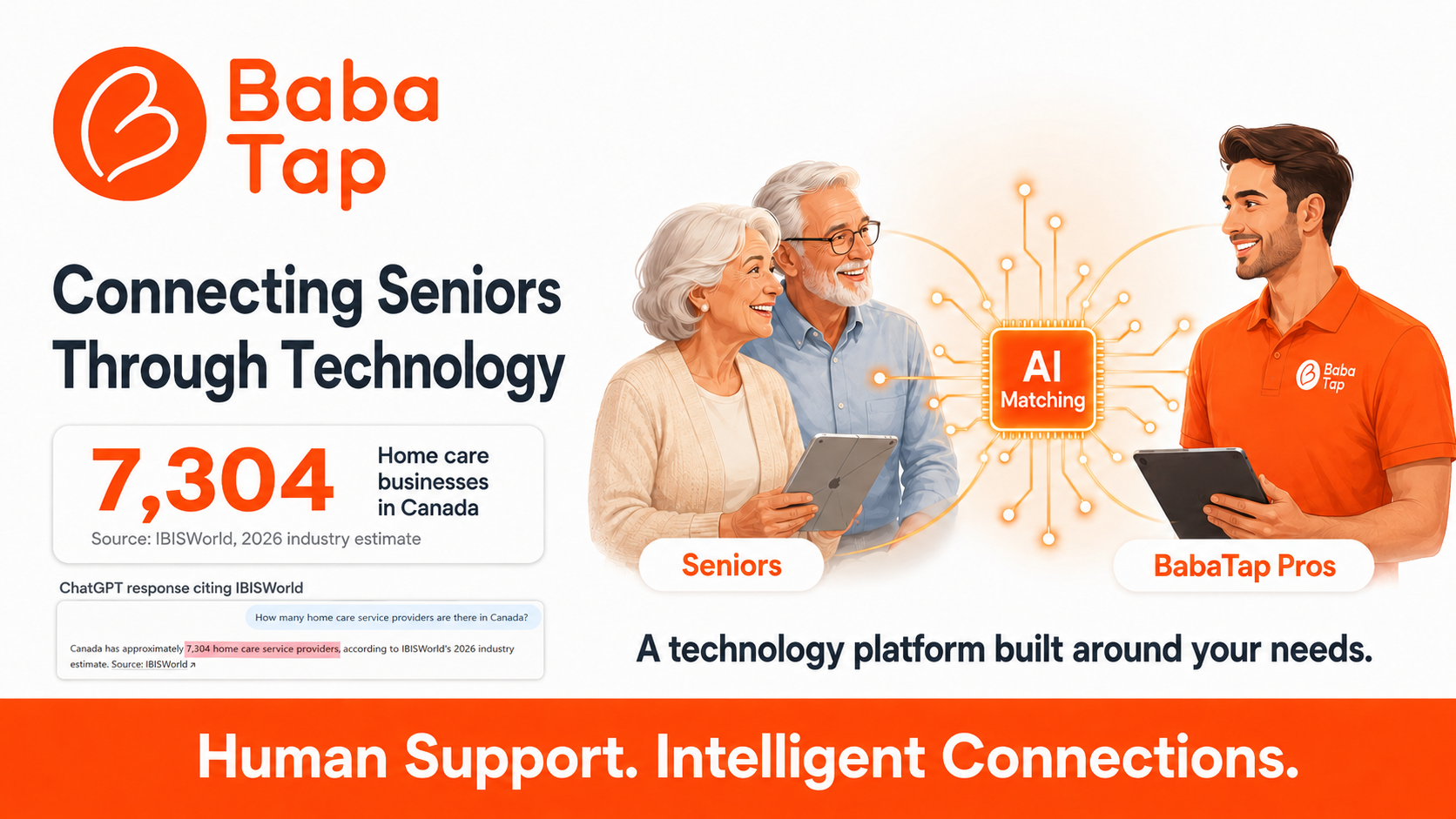
We recognize that technology is already part of Canada’s care landscape. BabaTap does not need to claim that every other provider operates without digital tools to explain its purpose. Our distinction is the central role that a technology platform plays in connecting service demand with a network of BabaTap Pros. The value of that approach depends on what it delivers for people: clearer service choices, more relevant connections, better coordination, and a practical way for families to organize support around the lives their loved ones want to maintain.
At the heart of this approach is BabaTap’s AI Matching concept: using relevant information about a service request and a professional’s profile to support a more suitable connection. The goal is to move beyond treating every available provider as interchangeable. A useful match requires attention to the task, the location, the requested time, and the type of support involved. AI Matching is intended to help organize these considerations so that connecting a senior with a BabaTap Pro becomes a more informed process.
The process begins with understanding what the senior actually needs. “Help at home” can describe many different situations, from preparing a simple meal to providing companionship during an afternoon. A useful request explains the activity, the expected duration, the location, and any relevant instructions. These details create the foundation for matching. Technology cannot reliably interpret needs that have never been communicated, so clear information from the customer or family remains essential. The platform’s role is to make that information useful when identifying an appropriate service connection.
The other side of the connection is the BabaTap Pro. A professional profile gives structure to information about the services a person offers and the area they serve. The matching approach is designed around comparing the request with that relevant profile information. Someone who provides technology assistance may be suitable for helping a senior understand a smartphone, while another professional may focus on errands or companionship. The purpose is to connect a request with an appropriate service offering, rather than assume every professional can perform every task.
Location is an important consideration because senior support happens in real communities. A professional’s proximity matters only when that person also serves the requested area and can reasonably attend the booking. A nearby professional may still be unavailable or unsuitable for a particular service. For this reason, BabaTap’s matching philosophy considers geographic relevance as part of the broader fit. The objective is to develop local connections that make practical sense for both the senior requesting assistance and the BabaTap Pro providing it.
Timing also influences whether a connection can become a successful booking. A request for companionship on a flexible afternoon differs from an appointment that must begin at a specific hour. A responsible matching process needs to distinguish between these situations. Identifying a potentially suitable professional is one step; confirming that the professional can accept the actual booking is another. BabaTap’s platform approach emphasizes this distinction because a suggested connection should not be mistaken for a guaranteed appointment before availability and service arrangements are confirmed.
Personal preferences can add important context when they are voluntarily shared and relevant to the service. A senior may prefer a quieter visit, need instructions explained slowly, or want support with a familiar routine. These considerations illustrate the kind of information that can make a connection more meaningful. They should not become promises that an algorithm can perfectly predict personality or compatibility. Our approach to AI Matching is grounded in practical suitability, while recognizing that trust and comfort develop through human interaction over time.
Consider a daughter arranging support for her father while she lives in another city. Her father remains independent but would appreciate assistance buying groceries and putting them away. The useful connection is not simply the first person available nearby. It is someone whose service offering fits the request, who can attend at the agreed time, and who understands the stated expectations. This example shows the purpose behind BabaTap’s technology: helping translate a family’s everyday concern into an organized request for appropriate local support.
A different senior may be comfortable managing household tasks but struggle with a new phone or tablet. The support needed might involve adjusting settings, explaining video calls, or showing how to use a familiar application. In this situation, matching should focus on the requested technology assistance rather than a general assumption about age. The senior remains an individual with specific abilities and preferences. BabaTap’s approach is built around responding to the task the person identifies, while respecting what they already manage confidently on their own.
AI Matching also has limits, and acknowledging them is part of responsible platform development. An algorithm cannot guarantee kindness, prevent every misunderstanding, or determine all the circumstances inside someone’s home. It should support service coordination without replacing human judgment. If a request is unclear, outside a professional’s abilities, or unsuitable for the platform’s scope, clarification is necessary. The objective is not to automate every decision. It is to use technology where it can help people make better-informed decisions about everyday assistance.
BabaTap focuses on non-medical support, which makes clear service boundaries especially important. Companionship, errands, meal preparation, and practical household assistance should not be presented as substitutes for clinical assessment or regulated healthcare. A technology platform must make the service understandable before a booking takes place. Matching someone with a helpful professional does not mean that professional is qualified to perform medical tasks. Families should be able to distinguish between everyday assistance and needs that require an appropriately qualified healthcare provider.
The platform model also brings attention to what happens after an initial match. A useful connection needs a clear service arrangement: what has been requested, where it will happen, and what the professional is expected to do. BabaTap’s approach treats matching as part of a broader service journey. The customer’s experience depends on whether the request remains understandable as it moves toward confirmation and delivery. Technology has practical value when it helps keep those details organized and reduces uncertainty between the people involved.
For families, clarity matters as much as convenience. The person booking may be a senior, an adult child, a spouse, or another authorized individual helping arrange support. Each needs enough information to understand the service without assuming that every detail can be shared with everyone. BabaTap’s platform philosophy recognizes both coordination and personal autonomy. Supporting a family’s involvement should remain compatible with respecting the senior’s preferences, consent, and control over their own everyday life.
Privacy belongs within this same discussion. Service coordination may involve addresses, contact information, and notes about practical assistance. Those details should be handled with care and shared only as reasonably necessary for the booking. BabaTap’s public guidance emphasizes limiting information sharing to what is needed to perform the service. A responsible use of technology starts with understanding why information is collected and how it helps deliver the requested support. More information is not automatically better information. Source: BabaTap
The experience of BabaTap Pros is equally important to the platform’s purpose. Professionals benefit from understanding a request before deciding whether it fits their services and availability. Clear expectations help them prepare and identify questions that need answers before arrival. From the platform’s perspective, a successful connection must work for both sides. A system that makes booking convenient for customers but leaves professionals uncertain about the task would not deliver the quality of coordination we want BabaTap to represent.
Technology can also support a more consistent way of presenting services across different communities. Families should not have to relearn the basic meaning of a booking every time they arrange assistance in another location. At the same time, consistency should not hide local differences. The availability of particular services and professionals can vary. BabaTap’s aim is to combine an understandable platform experience with accurate local information, so customers can see what is relevant to their request without assuming every service exists everywhere.
This distinction becomes especially important as a network grows. Adding a city to a website is not the same as having suitable professionals available for every request in that city. Sustainable expansion requires attention to local service coverage, professional readiness, and customer support. Our technology platform provides a framework for connecting people, but the strength of that connection still depends on the network behind it. Growth should make the experience more dependable, rather than simply increase the number of locations mentioned in marketing.
Feedback provides another opportunity to improve the experience. A customer may identify unclear instructions, while a BabaTap Pro may explain that a booking needed a more accurate description. Such observations can inform service guidance, support processes, and future matching improvements. BabaTap’s public information identifies feedback as a way to improve matching, quality, training, and customer support. This does not require claiming that every review automatically retrains an AI system. Listening carefully and making responsible improvements are valuable in their own right. Source: BabaTap
Affordability and value also deserve a practical explanation. A technology platform should not promise to be the cheapest option simply because it uses AI. Prices depend on the service, location, duration, and other applicable booking conditions. The more useful goal is to help customers understand what they are arranging and what it will cost. For BabaTap, value means connecting people with appropriate assistance through a process they can understand, while recognizing the time and contribution of the professional delivering that support.
Our broader vision also recognizes that senior independence involves needs that cross traditional service categories. A person may want companionship, transportation, and assistance maintaining personal routines at different times. BabaTap’s relationship with RideSenior and TapLook reflects an interest in making these complementary forms of support easier to understand within a broader service network. Each service still needs appropriate arrangements and clear responsibilities. The opportunity lies in helping families navigate related needs without treating every part of daily life as an entirely separate problem.
What matters most is the senior’s experience. A successful service might mean groceries are brought home, a confusing device becomes easier to use, or an afternoon feels less lonely because someone takes time to listen. These outcomes are personal and practical. Technology contributes by helping the connection happen and supporting its organization. The human value comes from the attention, patience, and respect shown during the service. BabaTap’s purpose is to bring these two elements together without allowing the technology to overshadow the person.
That is how we understand our place in a Canadian home care market containing more than 7,300 businesses. BabaTap’s identity rests on a platform approach to non-medical senior support, with AI Matching serving the goal of more relevant connections between seniors and BabaTap Pros. Our ambition is to make arranging everyday assistance clearer and more accessible while remaining honest about availability, service boundaries, and the limits of automation. As BabaTap develops, the standard that matters is whether our technology helps people receive thoughtful support and continue living with greater independence, dignity, and confidence.
BabaTap
Bài viết liên quan: