
Canada’s home care industry continued to experience strong growth in 2025, driven by an aging population, increasing demand for aging-in-place services, and ongoing pressure on hospitals and long-term care facilities. Across the country, millions of seniors now rely on home care providers for nursing, personal support, rehabilitation, companionship, and daily living assistance. As demand continues to outpace supply, several national home care organizations have expanded their operations through acquisitions, technology investments, and larger caregiver networks.
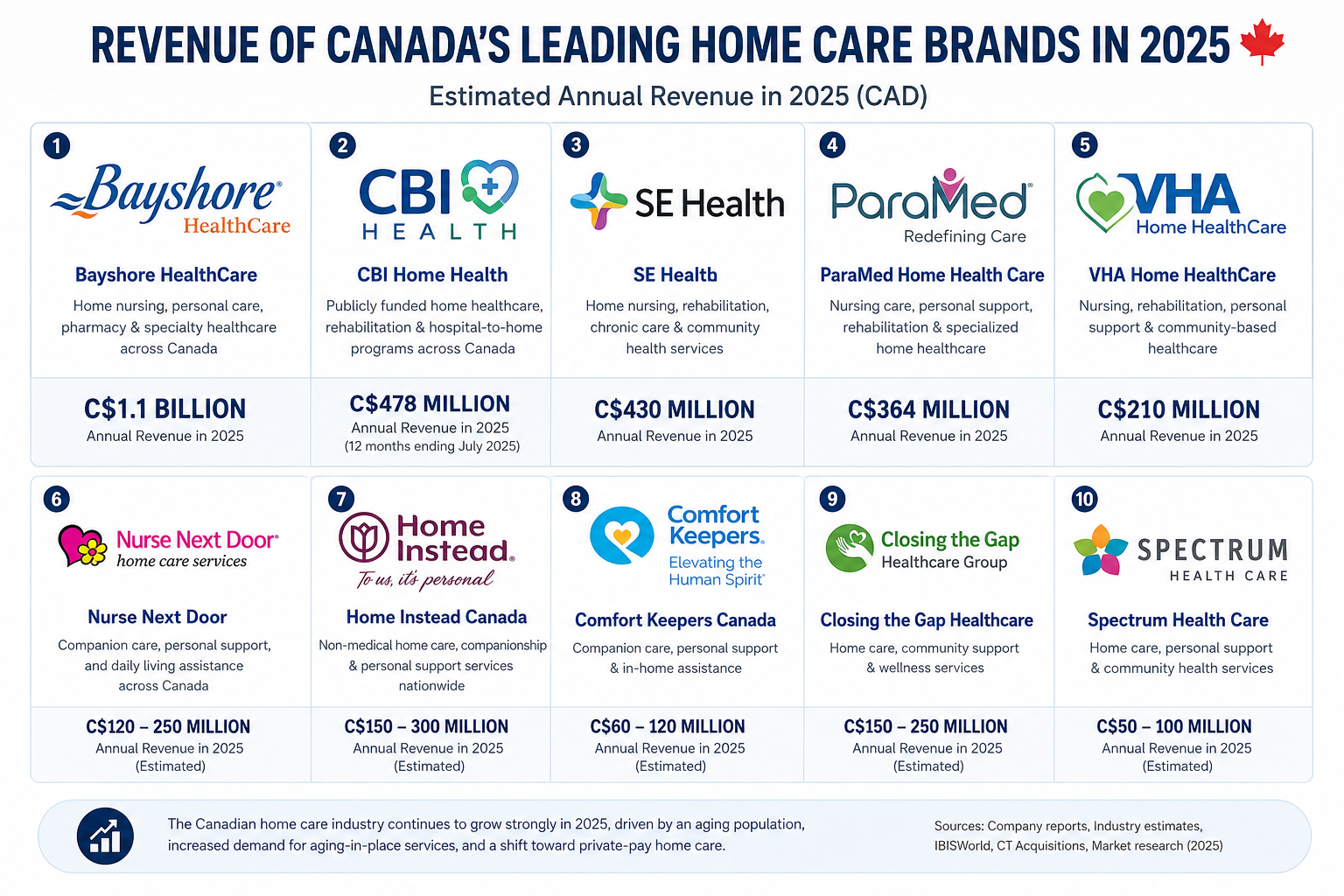
Among the largest providers, Bayshore HealthCare remains the clear market leader. Industry estimates place the company’s annual revenue at approximately C$1.1 billion in 2025, supported by thousands of healthcare professionals delivering home nursing, personal care, pharmacy services, and specialty healthcare across every province. Bayshore continues to be recognized as one of Canada’s largest integrated home and community care organizations.
CBI Home Health is another major national provider. Before its acquisition by Extendicare, the company generated approximately C$478 million in revenue during the twelve months ending July 2025. With more than 8,500 employees, CBI Home Health provides publicly funded home healthcare, rehabilitation, interdisciplinary care teams, and hospital-to-home programs throughout Canada.
SE Health, formerly known as Saint Elizabeth Health Care, remains one of Canada’s most recognized not-for-profit healthcare organizations. Industry estimates place its annual revenue at approximately C$430 million, supported by decades of experience in home nursing, rehabilitation, chronic disease management, and community care innovation. SE Health continues to play an important role in delivering publicly funded healthcare services while investing heavily in research and digital health initiatives.
ParaMed Home Health Care, now part of Extendicare, generated approximately C$364 million in annual revenue in 2025. The organization serves clients across multiple provinces and provides nursing care, personal support services, rehabilitation, and specialized home healthcare. ParaMed has also expanded its capabilities through strategic acquisitions, strengthening its position as one of Canada’s largest home care providers.
VHA Home HealthCare remains one of Canada’s largest charitable home care organizations, with estimated annual revenue of approximately C$210 million. The organization delivers nursing care, rehabilitation, personal support, and community-based healthcare while focusing on accessibility and equitable care for vulnerable populations.
Several other well-known brands continue to expand across Canada, including Nurse Next Door, Home Instead Canada, Comfort Keepers Canada, Closing the Gap Healthcare, Spectrum Health Care, Classic LifeCare, Integracare, and numerous regional providers. Although these organizations operate on a smaller scale than the national leaders, they continue to grow rapidly as private-pay home care becomes increasingly popular among Canadian families seeking personalized support for aging loved ones.
One of the most significant trends shaping the Canadian market is the rapid growth of private-pay home care. Industry analysts report that private-pay services have been expanding at annual rates approaching ten percent as more seniors choose to remain in their own homes rather than move into assisted living or long-term care facilities. This shift has attracted substantial investment from private equity firms and healthcare organizations, resulting in continued mergers, acquisitions, and technology adoption throughout the sector.
Despite the impressive size of these organizations, Canada’s home care industry remains highly fragmented, with more than one thousand providers operating across the country. This fragmentation creates opportunities for innovative technology platforms that focus on caregiver matching, scheduling, transparent pricing, digital booking, and customer experience rather than relying solely on the traditional agency model.
For entrepreneurs entering the senior care market, the greatest opportunity may not be building another conventional home care agency, but rather creating technology-enabled companion care platforms that complement existing healthcare services. As demand for companionship, transportation, wellness visits, grocery assistance, social engagement, and non-medical support continues to rise, companies that combine digital convenience with trusted local caregivers are well positioned to become the next generation of senior care providers in Canada.
BabaTap
Bài viết liên quan: