
When families search for Home Care in Hamilton : Can My Aging Parent Continue Living Independently at Home?, they are often trying to answer a deeply practical question: does an aging parent truly need to leave home, or could the right support help them continue living safely and comfortably in a familiar environment? For many older adults in Hamilton, Ontario, aging in place can remain a realistic option when everyday challenges are addressed early. Home care for seniors, senior care at home, elderly care at home, in home senior support, senior companion services, and home assistance for seniors are common ways families describe the support they are looking for. However, these terms can refer to very different services. Some involve medical or personal care, while others focus on companionship, transportation, grocery shopping, errands, light housekeeping, and practical help with everyday life. Hamilton has an established network of senior programs and community resources supporting older adults, including services related to health and well being, housing, transportation, recreation, and community participation. The City of Hamilton’s Age Friendly Hamilton initiative specifically recognizes that many older adults want to age in place in their own homes and familiar neighbourhoods, while also identifying transportation, housing, and community support as important factors in making that possible.
This distinction is particularly important for families considering Home Care for Senior Services. An aging parent may not need nursing care or intensive personal assistance. They may simply need someone to drive them to the grocery store, help with shopping, assist with light household tasks, accompany them to appointments, run errands, or provide regular companionship.
Ontario also recognizes several levels of support for people who want to remain at home. Ontario Health atHome can coordinate eligible home and community care, while community support services can include transportation, friendly visiting, home help, homemaking, meal delivery, social programs, and other assistance that supports independent living. Private companies can provide additional services for a fee.
Therefore, the question is not simply whether your parent needs “home care.” The more useful question is what kind of support would allow your parent to continue living independently while maintaining dignity, choice, familiar routines, and connection to the Hamilton community.

What Does Independent Living Mean for an Aging Parent?
Independent living does not necessarily mean doing every task without assistance.
An older adult can still be independent while receiving help with certain activities.
For example, your parent may be able to prepare meals, manage their normal personal routine, communicate clearly, make household decisions, and move comfortably around their home.
At the same time, they may find certain tasks increasingly tiring.
Grocery shopping may take longer.
Driving may become less comfortable.
Cleaning may require more effort.
Carrying laundry may become inconvenient.
Going to appointments may require transportation.
Spending long periods alone may become less enjoyable.
None of these situations automatically means that your parent can no longer live independently.
Instead, they may indicate that the senior could benefit from additional support.
This is why aging in place is often better understood as a support model rather than a complete absence of assistance.
The City of Hamilton’s Age Friendly Hamilton plan recognizes that older adults need access to housing, transportation, health and community services, and other supports that allow them to remain in their homes and communities.
The goal is to create an environment in which your parent can continue doing the things they are capable of doing while receiving help with the tasks that have become more difficult.
Signs Your Aging Parent May Benefit From Home Support
Families sometimes wait until a problem becomes serious before considering senior support.
A better approach is to watch for gradual changes.
One sign may be that your parent has stopped doing activities they previously enjoyed.
Perhaps they used to go shopping every week but now ask family members to do it.
Maybe they previously attended community activities but have stopped because transportation is inconvenient.
They may still be physically capable of participating but no longer want to deal with the effort involved.
Another sign is a change in household routines.
You may notice that the home is less organized than usual, laundry is accumulating, or grocery shopping is happening less frequently.
These changes do not necessarily mean your parent needs intensive care.
They may simply indicate that certain everyday responsibilities have become burdensome.
Transportation is another important consideration.
If a senior stops driving, their ability to access stores, social activities, appointments, community centres, and other destinations may become more limited.
The City of Hamilton identifies mobility and access to safe and accessible transportation as important considerations for older adults. Hamilton also provides information about accessible transportation options, including Accessible Transportation Services and DARTS for eligible residents.
Social isolation can be another warning sign.
A parent may live independently but spend most days alone.
Regular companionship can help create a more active routine and encourage participation in community life.
The important point is to look at the entire picture rather than focusing on one individual task.

Home Care Does Not Always Mean Medical Care
The phrase “home care” can create confusion.
When people search online for Home Care for Senior Services in Hamilton, they may be looking for completely different types of assistance.
Some seniors require professional health care at home.
Others need personal care.
Others primarily need practical support and companionship.
Ontario’s home and community care system includes health related services for people who require care in their homes or communities. Eligible individuals may receive government funded services through Ontario Health atHome. Ontario also explains that community support services can include transportation, friendly visiting, home help, homemaking, meal delivery, social and recreational programs, and other services designed to help seniors live independently.
For a family using the term “home care” to describe practical assistance, it is important to look at the actual scope of a service.
A companion service is not the same thing as medical home health care.
A companion may help with transportation, grocery shopping, errands, light housekeeping, and social interaction.
A medical professional may provide clinical services that require professional qualifications.
Knowing this difference helps families choose the appropriate support without assuming that every senior needs the same level of care.
Why Many Seniors Prefer to Remain at Home
Home represents familiarity.
It is where your parent knows where everything is located.
It may be close to longtime neighbours, friends, favourite stores, community centres, places of worship, parks, and familiar streets.
Moving to a different environment can involve major emotional and practical changes.
For this reason, aging in place can be meaningful when it remains safe and appropriate.
Hamilton’s Age Friendly Hamilton initiative explicitly states that most older adults want to age in place in their own homes and familiar neighbourhoods. The initiative also emphasizes the need for supports that facilitate aging in place.
This does not mean remaining at home should always be the goal regardless of circumstances.
Rather, families should determine whether the home environment can continue to work with appropriate support.
In some cases, relatively simple assistance can make a substantial difference.
Transportation Support Can Protect Independence
Transportation is one of the most important components of independent living for older adults.
Without reliable transportation, a senior may gradually become less active.
They may stop shopping independently.
They may skip community events.
They may rely entirely on adult children for appointments and errands.
They may spend more time at home simply because leaving is inconvenient.
Hamilton offers several transportation resources for seniors and people with mobility limitations. The City lists Accessible Transportation Services for residents whose physical or functional limitations prevent them from using regular HSR buses, as well as DARTS, a shared ride service providing door to door transportation for eligible users.
Private companion transportation can provide another form of personalized assistance.
The difference is that the companion can potentially accompany the senior throughout the outing.
For example, instead of simply being dropped at a grocery store, the senior can have someone accompany them while they select their own groceries.
That can preserve independence while reducing the practical challenges associated with the trip.

Grocery Shopping and Errand Assistance
Grocery shopping may seem simple until several small challenges accumulate.
Your parent may need transportation.
They may need to carry bags.
They may have difficulty reaching certain products.
They may need help organizing several errands into one outing.
A companion can provide practical assistance while allowing the senior to remain involved.
This distinction matters.
The objective is not necessarily to do everything for the senior.
The objective can be to make it easier for them to continue participating in their own daily life.
The same principle applies to errands.
A senior may want to visit a local store, pick up household supplies, return an item, collect groceries, or complete another everyday task.
Having someone available can make these activities more manageable.
Light Housekeeping and Household Assistance
Maintaining a home can become increasingly demanding as people age.
A senior may still be capable of cleaning but find larger household tasks exhausting.
Light housekeeping support can reduce that burden.
Depending on the provider, services may include tidying, laundry assistance, household organization, and other practical tasks.
Hamilton’s community resources recognize household assistance as part of the broader network of supports that can help older adults remain at home.
The City’s Age Friendly Hamilton materials highlight community based programs that support aging in place, while Ontario identifies home help and homemaking among community support services available in different areas.
Families should always confirm what tasks a private companion service is permitted and prepared to provide.
Companionship Is an Important Part of Senior Well Being
Companionship is sometimes overlooked because it does not look like a traditional “care” service.
Yet regular social interaction can be a meaningful part of an older adult’s daily routine.
A companion can provide conversation, accompany a senior during an outing, participate in hobbies, help them attend community activities, or simply spend time together.
Hamilton provides multiple opportunities for older adults to participate in recreation and social programs. The City offers programs for adults 55 and older, including activities at senior centres and other locations.
For an aging parent who spends a significant amount of time alone, having regular companionship can provide structure and connection.
It can also make it easier for them to continue participating in the community.
Companionship does not replace family.
Instead, it can complement family relationships by providing another source of practical and social support.
How Family Members Can Recognize the Need for Help
Adult children often notice changes before their parents do.
A parent may say everything is fine, while the family notices that groceries are becoming less frequent, the home is harder to maintain, or social activities have declined.
A useful approach is to observe patterns rather than focusing on isolated incidents.
Ask yourself:
Has my parent stopped doing activities they used to enjoy?
Are errands becoming more difficult?
Is transportation becoming a problem?
Is the household becoming harder to maintain?
Does my parent spend most of the day alone?
Are family members becoming responsible for more and more everyday tasks?
Is my parent asking for help more frequently?
If the answer to several of these questions is yes, it may be time to explore additional support.
That does not necessarily mean moving your parent into a different living environment.
It may simply mean adding practical assistance to the existing routine.
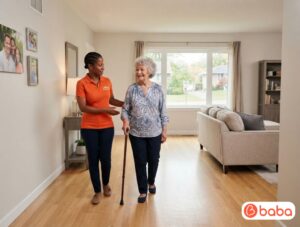
Start With the Tasks That Are Most Difficult
When families introduce home support, they do not necessarily need to change everything at once.
Start by identifying the specific tasks causing the most difficulty.
If transportation is the problem, begin with transportation.
If grocery shopping is difficult, focus on shopping assistance.
If the house is becoming harder to maintain, consider light housekeeping.
If loneliness is the main concern, consider regular companionship.
This approach makes the transition easier.
It also allows the senior to remain involved in deciding what kind of support they want.
Instead of saying, “You cannot manage on your own anymore,” families can say, “Let’s find someone who can make grocery shopping easier.”
That difference in language can matter.
It emphasizes support rather than dependence.
Supporting Independence Rather Than Replacing It
Good companion support should complement an older adult’s abilities.
Suppose your parent is capable of choosing groceries.
The companion can provide transportation and help carry the bags.
Suppose your parent enjoys going for walks.
The companion can accompany them.
Suppose your parent enjoys visiting a local community centre.
The companion can help with transportation and companionship.
The senior remains involved.
This approach can preserve a sense of control.
Independence is not measured by how many tasks a person performs completely alone.
It can also be measured by how much control they continue to have over their own choices and routines.
Creating a Weekly Routine for Senior Support
A predictable schedule can make companion services easier for both seniors and families.
For example, a weekly arrangement might include transportation and grocery shopping on one day, light household assistance on another day, and companionship or a community outing later in the week.
The exact schedule should depend on the senior’s needs.
The purpose is to create consistency.
A predictable routine can help a senior know when support is available without making them feel that their entire life has changed.
It also gives family members peace of mind because they know when someone will be checking in.
Combining Private Support With Hamilton Community Resources
Families do not necessarily have to choose one source of support.
Hamilton has a broad network of resources for adults 55 and older.
The City provides information about health and well being, housing, transportation, recreation, financial supports, and government services for older adults. It also directs residents toward Ontario 211 as a source of information about social, government, health, food, housing, and home care services.
Ontario also identifies Community Support Services as a way for seniors and people with disabilities to receive assistance that helps them remain safely and independently at home. Services vary by location and can include friendly visiting, home help, homemaking, transportation, meal delivery, social programs, and other supports.
Private companion services can complement these programs.
For example, a family might use community transportation for certain needs while arranging private companion support for grocery shopping or regular companionship.
The goal is to create a flexible support network around the senior.

What to Ask When Choosing Senior Home Support in Hamilton
Families searching for senior care at home should ask practical questions before choosing a provider.
Does the service provide non medical companion support?
Can companions assist with transportation?
Can they accompany seniors while shopping?
Is grocery shopping support available?
Can they assist with errands?
Is light housekeeping available?
Can services be scheduled regularly?
How are companions selected?
Can the service accommodate a senior’s preferred schedule?
What happens if a companion is unavailable?
What activities are outside the service’s scope?
These questions help clarify whether a service is appropriate for the senior.
They also prevent families from assuming that a companion service provides medical or personal care when it does not.
When Companion Support May Be the Right Fit
Companion services can be particularly appropriate for an aging parent who remains capable of managing personal routines but needs help with everyday activities.
For example, your parent may be independent but no longer drive.
They may manage their home but find cleaning tiring.
They may prepare meals but need help shopping for groceries.
They may be comfortable living alone but want more regular social interaction.
They may enjoy community activities but need assistance getting there.
These are situations where practical support can potentially make independent living easier.
When Your Parent May Need More Specialized Care
There are also circumstances in which companion services alone may not be sufficient.
Families should pay attention to serious changes involving safety, mobility, memory, personal care, medication management, or health needs.
If your parent is experiencing significant difficulties that require professional assessment or clinical assistance, an appropriate health care professional or Ontario Health atHome should be consulted.
Ontario explains that Ontario Health atHome coordinates home and community care for eligible people, including services that can help seniors and people with complex medical needs remain at home.
This creates an important distinction.
A senior may benefit from companion support while also receiving professional health services.
The two forms of support can serve different purposes.
Hamilton’s Aging in Place Approach
Hamilton’s Age Friendly Hamilton initiative provides useful context for families thinking about long term independence.
Its plan recognizes the importance of housing, transportation, health, community services, social participation, and other factors that influence how older adults experience aging in their communities.
The initiative specifically identifies the need for supports that facilitate aging in place and recognizes transportation as an important part of enabling older adults to participate in community life and access essential services.
This reinforces an important idea.
Independent living is not only about what happens inside the home.
It also depends on whether the senior can remain connected to the community outside the home.
Transportation, social activities, grocery access, appointments, recreation, and companionship all contribute to a sustainable lifestyle.
Senior Community Activities Can Support Independence
Remaining at home does not mean staying isolated at home.
Hamilton provides a variety of programs for adults 55 and older.
The City’s older adult programs include social, fitness, recreational, and skill based opportunities, with activities available through senior centres and other community locations.
For an aging parent, participation in community activities can provide structure and opportunities for social connection.
A companion can potentially make participation easier by helping with transportation or accompanying the senior, depending on the service provided.
This can be particularly valuable for older adults who are reluctant to attend activities alone.
How BabaTap Pro Can Support Aging Parents in Hamilton
For families searching for Home Care for Senior Services in Hamilton, BabaTap Pro can serve a practical role as a non medical companion service.
The focus is on everyday assistance rather than medical treatment.
Depending on the senior’s needs and the services available, support can centre around activities such as transportation, grocery shopping, errands, light household assistance, and companionship.
This can be especially relevant because families often search for “home care for seniors,” “senior care at home,” or “elderly care at home” even when the actual need is non medical support.
A parent may not need a nurse.
They may need someone to help them get groceries.
They may not need residential care.
They may need a companion for errands.
They may not need someone to manage their personal care.
They may simply want another person around during part of the week.
BabaTap Pro can fit into that space by helping seniors with practical everyday needs while allowing them to remain involved in their own routines.
The objective is not to replace family members.
It is to complement the support that family members already provide.
A Practical Example of Aging in Place in Hamilton
Consider an older adult living independently in Hamilton.
They have lived in their home for years and want to remain there.
They can prepare meals, manage their personal routine, communicate with family, and make their own decisions.
However, driving has become less convenient.
Grocery shopping is tiring.
The house requires occasional light cleaning.
They also spend several weekdays alone.
The family could respond by creating a practical support plan.
A companion might provide transportation for grocery shopping.
Another visit could focus on light household tasks.
Another could include companionship and an outing.
The senior remains responsible for decisions.
Family members continue to visit and participate.
Hamilton community programs provide additional opportunities for recreation and social connection.
If the senior’s needs change, the family can reassess the arrangement.
This example illustrates how independent living can evolve without immediately becoming residential care.
Why Starting Support Early Can Be Helpful
Families sometimes wait until a parent is struggling significantly before introducing assistance.
Starting earlier can make the transition more comfortable.
A senior can become familiar with having a companion before their needs become more substantial.
The family can learn which types of support are actually useful.
The senior can provide feedback about preferences.
The arrangement can be adjusted gradually.
Early support can also prevent family members from becoming overwhelmed by trying to handle every task themselves.
The objective is not to predict exactly what the senior will need years from now.
It is to address today’s challenges while remaining flexible about tomorrow.
A Simple Framework for Families
When deciding whether your aging parent can continue living independently at home, consider five areas.
1. Daily Activities
Can your parent manage their usual routine?
If yes, identify the specific tasks that are becoming difficult.
2. Transportation
Can your parent get to groceries, appointments, social activities, and other important destinations?
If transportation is the main barrier, explore community and private transportation options.
3. Household Responsibilities
Can your parent maintain the home comfortably?
If not, determine whether light housekeeping or household assistance could help.
4. Social Connection
Does your parent regularly interact with family, friends, neighbours, or community groups?
If not, companionship and community activities may be valuable.
5. Safety and Health
Are there serious concerns that require professional assessment or medical support?
If so, contact the appropriate health care provider or Ontario Health atHome rather than relying solely on companion services.
This framework can help families distinguish between practical support needs and situations requiring specialized care.
Final Thoughts: Can My Aging Parent Continue Living Independently at Home?
For many Hamilton families, the answer may be yes, provided the right support is available.
An aging parent does not necessarily have to choose between doing everything alone and moving into residential care.
There can be a middle ground.
That middle ground may include transportation assistance, grocery shopping, light housekeeping, errands, companionship, community programs, family involvement, and professional health services when required.
Hamilton has a strong community focus on aging in place. The City provides resources for older adults related to transportation, housing, health and well being, recreation, and community services, while Ontario provides home and community care pathways for seniors who require more specialized assistance.
For families searching online for Home Care for Senior Services, the most important step is to understand what their parent actually needs.
If the challenge is getting groceries, find grocery support.
If transportation is difficult, find transportation assistance.
If household tasks are becoming tiring, consider light housekeeping.
If loneliness is becoming a concern, consider companionship.
If serious health or safety issues are emerging, seek professional care.
The right support should fit the senior rather than forcing the senior into a predetermined model of care.
For an older adult who remains capable of living independently but needs assistance with everyday activities, a companion service can provide valuable support while preserving personal choice.
BabaTap Pro’s non medical companion approach can be part of that support network, helping seniors with practical activities such as transportation, grocery shopping, errands, household assistance, and companionship.
Independent living does not have to mean doing everything alone.
It can mean having the right support around you so that you can continue living in the home and community you know and value.
For an aging parent in Hamilton, that distinction can make all the difference.
Choose the support that fits your needs. BabaTap provides flexible, non-medical companion and everyday support services for older adults, available by the hour in Hamilton. Friendly visits, conversation and emotional support. Safe rides to appointments, shopping and errands. Help with groceries, errands and everyday essentials. Friendly check-ins for comfort, connection and reassurance. Fresh, simple meal preparation and everyday kitchen support. Light housekeeping and help keeping the home organized. Companion support during hospital visits and care waits. Companionship for walks and light activity to stay active. Flexible non-medical support for everyday life at home. Meaningful companionship and non-medical senior support. BabaTap focuses on flexible, non-medical senior support. Service availability may vary by city and BabaTap provider.BabaTap Services by the Hour in Hamilton

Friendly Companion

Transportation

Grocery & Errands

Check-in Visits

Meal Preparation

Light Home Support

Hospital Companion

Walk & Exercise

Home Care

Companion Care
Bài viết liên quan: