For many years, conversations about aging have focused heavily on healthcare, housing, transportation, and personal care. These services are essential, but there is another need that is quieter, less visible, and often much harder to measure: the need for human connection. An older adult may have a safe home, access to medical care, enough food, and family members who care deeply about them, yet still spend long periods without meaningful conversation or regular social interaction. A son or daughter may call whenever possible, but work, children, distance, and everyday responsibilities can make consistent companionship difficult. A senior may remain independent and require no medical assistance at all, while still wishing there were someone to talk with, someone who remembered to call, or simply someone interested in hearing about their day.
BabaTap was created with an understanding of this gap. Our broader vision has always been centered on practical, human support for older adults. Through a network of local BabaTap Pros, the platform connects seniors and families with non-medical services such as companionship, transportation, errands, technology help, meal preparation, light home support, hospital companionship, and other forms of everyday assistance. At the beginning, it seemed natural that senior companionship should exist entirely within this service model. Someone needs companionship, a provider gives their time, and the family or senior pays for that service just as they would for transportation, an errand, or another form of practical support.
As we continued developing the model, however, an important distinction became increasingly clear. Not every form of companionship should necessarily be treated as a commercial transaction.
There are situations where paid professional companionship makes complete sense. A senior may need a BabaTap Pro to spend several hours with them, accompany them into the community, visit them at home, remain with them during a hospital appointment, help with errands, prepare a simple meal, provide transportation, or combine companionship with other practical assistance. These activities involve substantial commitments of time, transportation, scheduling, responsibility, and in-person service. A sustainable paid model allows providers to commit meaningful time to this work and gives families access to structured support when they need it.
But there is another kind of companionship that is fundamentally different. Sometimes an older adult simply needs a conversation.
They may appreciate a friendly phone call once or several times during the week. They may want to talk about their garden, their grandchildren, the weather, a television program, their memories, or what happened during their day. They may enjoy hearing another person ask, “How are you doing today?” and genuinely remain on the line to hear the answer. They may not require someone to drive across the city or spend several hours in their home. They may simply need another human being to connect with them.
The more we considered this need, the more we began asking ourselves a different question. If meaningful companionship can sometimes be provided through a simple conversation between two people, should access to that conversation always depend on someone’s ability or willingness to pay?
Our answer gradually became no.
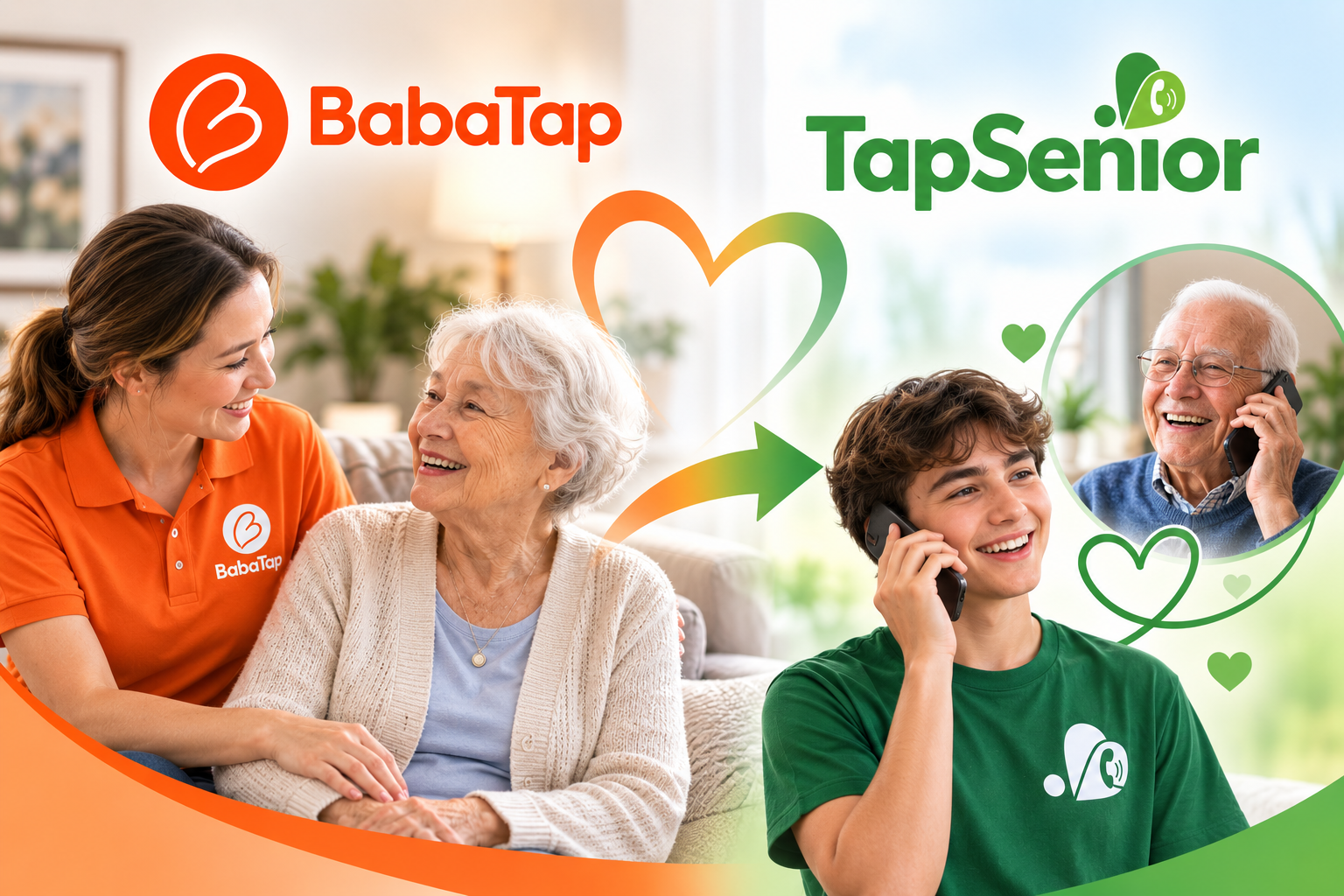
That realization is behind an important evolution in the BabaTap ecosystem. BabaTap is moving away from treating community-based companionship as something that must exist entirely within a commercial service model. Instead, BabaTap is transferring the knowledge, structure, experience, and community-oriented direction behind this part of the program to TapSenior, allowing TapSenior to develop a completely free senior companionship initiative powered by volunteers.
This is not BabaTap abandoning companionship. It is companionship being divided into two models so that each can serve a different purpose more effectively.
BabaTap will continue to have an important role when seniors and families need structured, in-person, non-medical support delivered by BabaTap Pros. Companion Visits and other practical services can remain part of a professional service environment because they require providers to dedicate significant time and often involve transportation, scheduling, travel, and additional responsibilities. TapSenior, meanwhile, can focus on building the community side of companionship, particularly opportunities where volunteers can connect with seniors through friendly conversations and social connection without requiring the senior to purchase a service.
The distinction matters because our goal is not to make every interaction with an older adult a transaction.
There are moments when a professional service is appropriate, and there are moments when community kindness is enough. Building a responsible senior-support ecosystem means understanding the difference.
TapSenior provides a natural home for this community model. Its purpose can extend beyond simply offering benefits or membership connections for older adults. It can become a platform that brings generations together, encourages volunteer participation, creates opportunities for meaningful conversations, and gives seniors another way to remain socially connected to the communities around them.
Under this direction, a volunteer might be a university student who wants to contribute a few hours each month. It might be a high school student looking for meaningful community involvement. It might be a working professional who has limited time but would happily make a regular phone call in the evening. It could be a retiree who understands how valuable conversation can be and wants to spend time speaking with another older adult. It might be someone who lives hundreds of kilometres away from the senior they speak with and yet can still create a meaningful connection through a telephone conversation.
The simplicity of the idea is precisely what gives it potential.
Traditional in-person services are naturally constrained by geography. If a provider lives in Edmonton, that provider can realistically serve only Edmonton and nearby communities. Transportation time, distance, scheduling, and cost determine how many people can be supported. A volunteer companionship call works differently. A volunteer in Edmonton could potentially speak with a senior elsewhere in Alberta. A volunteer in Toronto could connect with someone in another community. Geography becomes less important, while language, interests, availability, and compatibility can become more meaningful factors in creating connections.
This does not mean that telephone companionship can replace in-person relationships. It cannot, and it should not try to. Human beings need different forms of connection, including family relationships, friendships, neighbourhood interaction, community activities, and face-to-face companionship. The purpose of a volunteer call is not to become the senior’s entire social world. It is to add another connection to that world.
Sometimes one additional connection matters.
A regular call can give someone something to anticipate. A volunteer can remember that a senior was planning to visit a family member and ask about it the next time they speak. They can discuss a shared interest. They can laugh about something ordinary. Over time, repeated conversations may create familiarity and a sense that someone outside the senior’s immediate family is interested in their life.
These interactions may appear small when viewed individually, but community is often built through small, repeated acts rather than dramatic gestures.
This is also why we believe a volunteer-powered model deserves to be developed carefully rather than simply treated as an informal collection of people making random calls. “Free” should never mean unstructured, careless, or without responsibility. TapSenior’s challenge is to create a program that remains simple enough for volunteers to participate in while establishing clear expectations around privacy, respect, boundaries, appropriate communication, safety, and the non-medical nature of the program.
Volunteers are companions, not healthcare professionals. They should not diagnose medical conditions, provide clinical advice, manage medication, offer professional counselling, make financial decisions for seniors, or represent themselves as substitutes for regulated services. When a senior requires medical, psychological, emergency, legal, financial, or other professional assistance, the appropriate qualified services must remain responsible for those needs.
The role of a volunteer is much more human and much simpler: to connect.
This clarity is important for seniors as well. Participating in a volunteer companionship program should not create the expectation that a volunteer will become a caregiver or take responsibility for complex personal needs. The relationship should be built around friendly conversation, respectful social interaction, and community connection.
Keeping the program focused also makes it more sustainable.
Volunteer programs sometimes begin with tremendous enthusiasm but gradually become difficult to maintain because expectations expand too quickly. A volunteer who initially agrees to make a friendly call may eventually feel responsible for solving problems far beyond the original purpose of the program. That is not fair to the volunteer and may not be appropriate for the senior. TapSenior therefore has an opportunity to build a model where the boundaries are understandable from the beginning.
A strong community program should also respect the volunteer’s contribution. Free service does not mean volunteer time has no value. In fact, the opposite is true. A person who chooses to give part of their time without expecting payment is contributing something meaningful to the community, and that contribution deserves organization, recognition, and respect.
Young volunteers may also gain something valuable from the experience.
Many younger people have limited opportunities to have extended conversations with older adults outside their own families. Generations increasingly live in different social and digital environments. A teenager may communicate primarily through messages and social media while an older adult may prefer a telephone conversation. A university student may be thinking about education and a future career while the person on the other side of the call may have decades of life experience, stories, mistakes, successes, and memories to share.
Bringing those people into conversation can create an exchange rather than a one-directional act of charity.
The volunteer gives time and attention. The senior gives stories, perspective, humour, knowledge, and life experience. Both people have something to contribute.
That principle is important to TapSenior because we do not want older adults to be portrayed simply as people waiting to receive help. Seniors are members of our communities with knowledge, preferences, personalities, histories, skills, and experiences. A good companionship program should recognize that dignity. The conversation is not between a “helper” and a “recipient” in every moment. It is between two people.
This philosophy is one reason BabaTap believes the community companionship program can grow more naturally under TapSenior.
BabaTap remains fundamentally connected to the delivery of practical services. Families come to BabaTap because they need something specific to happen: someone to visit, someone to accompany an older adult, someone to help with an errand, someone to provide transportation, someone to assist with technology, or someone to be physically present. There are operational responsibilities associated with those requests, and the people performing them deserve to be compensated for their time and work.
TapSenior can approach the relationship from another direction. It can ask not only, “What service does this senior need?” but also, “How can this senior remain connected to the community?”
Those are related questions, but they are not identical.
Separating the models also allows both organizations to remain clearer about their purpose. BabaTap does not have to force every form of companionship into a paid booking structure, and TapSenior does not need to become another commercial home-support provider. Each can develop around what it is best positioned to accomplish.
A senior could therefore potentially participate in the TapSenior community without purchasing anything. They might receive friendly volunteer calls and participate in future community initiatives simply because they are an older adult who wants more social connection. If, at another time, that senior or their family needs someone physically present for a longer period, transportation, errands, hospital companionship, or another practical non-medical service, they can independently consider whether a professional service such as BabaTap is appropriate.
There should be no requirement that a free TapSenior relationship must convert into a paid BabaTap booking.
That principle is essential.
A volunteer program loses much of its meaning if every conversation is secretly treated as a sales opportunity. Seniors should be able to participate in community companionship without wondering whether kindness will eventually become a commercial pitch. Volunteers should also be able to participate because they want to contribute rather than because they are expected to generate customers.
TapSenior should therefore be able to build trust on its own terms.
At the same time, having BabaTap and TapSenior within a broader senior-focused ecosystem can still be useful because families often encounter different needs over time. The important distinction is that awareness and choice are different from pressure. Information about additional resources can exist when relevant, but the volunteer relationship itself should remain centered on community connection.
The decision to make this program free also reflects a broader belief about accessibility.
Even relatively affordable paid services can become difficult when used frequently. A companionship call may seem inexpensive as an individual service, but if a senior wants regular conversations throughout the year, repeated fees can accumulate. More importantly, requiring payment introduces a psychological barrier. Some seniors may feel uncomfortable asking family members to pay simply because they want someone to talk with. Others may decide that companionship is not “important enough” to spend money on, even when they would genuinely appreciate more social interaction.
Removing the price removes that decision.
A senior does not have to calculate whether a conversation fits within a monthly budget. A family does not have to decide how many calls they can afford. A volunteer does not have to think about how much each conversation costs. The interaction can remain what it was meant to be: one person making time for another.
Of course, free programs still have costs. Technology, administration, communication, volunteer coordination, screening processes, training resources, program development, and other operational requirements do not disappear simply because participants are not charged. Building a sustainable free program therefore requires careful design and responsible growth.
This is another reason BabaTap’s role in the transition matters.
Rather than simply stopping one model and leaving TapSenior to start from zero, BabaTap can transfer what it has learned about senior support, service boundaries, communication, community needs, and operational structure. TapSenior can use that foundation while designing a volunteer program specifically for a non-commercial environment.
The goal is not rapid expansion at any cost.
A community program should grow at the pace at which it can maintain trust. One hundred meaningful, appropriately managed connections are more valuable than thousands of registrations that receive little follow-up. Volunteer recruitment must therefore develop alongside senior participation. Communication systems need to remain understandable. Expectations must remain realistic. Feedback from both seniors and volunteers should help shape how the program evolves.
Over time, technology can make this easier without removing the human element.
TapSenior can potentially use technology to coordinate volunteer availability, language preferences, general interests, scheduling, reminders, and program records. Technology can reduce administrative work and help people find appropriate connections, but the conversation itself should remain human. The objective is not to build an artificial companion that replaces volunteers. It is to use technology to help real people find one another and maintain consistent contact.
That distinction reflects a broader philosophy shared across the ecosystem.
Technology is most valuable when it makes human support easier to access, not when it automatically removes humans from every interaction.
For older adults, this philosophy can be particularly meaningful. Digital tools are increasingly involved in healthcare appointments, transportation, communication, shopping, banking, and everyday services. While these technologies provide enormous convenience, they can also make life feel more automated. A volunteer companionship program moves in the opposite direction. Technology may coordinate the connection behind the scenes, but what the senior experiences is a real voice, a real conversation, and a real person choosing to spend time with them.
The potential community impact becomes even more interesting when the model is considered across cities.
Imagine volunteers participating from Edmonton, Calgary, Vancouver, Toronto, Montreal, Halifax, Winnipeg, and smaller communities. Some may prefer to speak English, others French, and others may be able to connect with seniors in additional languages. Some may have one hour available each week, while others may participate occasionally. Retired volunteers may prefer daytime conversations, students may prefer evenings or weekends, and working adults may have different schedules.
A community network does not require every volunteer to contribute the same amount of time.
It requires many people to contribute what they realistically can.
This makes participation more accessible. Someone does not need to turn volunteering into a second job. A person who can consistently offer a small amount of time may still create a meaningful relationship with an older adult. When multiplied across hundreds or eventually thousands of volunteers, small contributions can create a substantial network of human connection.
TapSenior can also provide an environment where volunteering becomes part of everyday community culture rather than something people participate in only during major campaigns or special events.
A regular conversation is simple. It does not require a fundraising event, a large venue, or complicated logistics. It requires commitment, empathy, appropriate boundaries, and time.
That simplicity may allow people who have never considered volunteering before to participate.
For students, it can be an introduction to community service. For adults, it can be a manageable way to give back while balancing work and family. For retirees, it can provide another opportunity to contribute experience and remain engaged. For newcomers to a community, volunteering may even provide a meaningful way to connect with people from different generations and backgrounds.
None of this means professional companionship has become unnecessary.
There will always be situations where a senior needs someone physically present. Telephone conversations cannot accompany a person to an appointment, help with groceries, provide transportation, sit beside someone during a long hospital visit, assist with a household task, or spend several hours together in person. These needs involve real labour and responsibility, and professional providers should be compensated appropriately.
This is why BabaTap continues to have a distinct role.
BabaTap can focus its resources on building a strong network of BabaTap Pros who provide reliable, practical, in-person non-medical services. Rather than trying to make one model solve every problem, the ecosystem can recognize that community volunteering and professional services each have a legitimate place.
The transition therefore represents specialization rather than withdrawal.
BabaTap is not stepping away from seniors. It is becoming clearer about where a professional service model creates the most value, while TapSenior becomes clearer about where a community model can create impact without charging the senior.
That clarity can make both organizations stronger.
For BabaTap Pros, it reinforces the value of their professional work. They are not being asked to donate unlimited time under a business platform. When they provide structured in-person services, their time, effort, transportation, and responsibilities remain recognized as professional contributions.
For TapSenior volunteers, the opposite principle applies. They enter the program knowing that their role is community service. Their motivation is not a payout at the end of a booking but the opportunity to contribute their time and create a human connection.
For seniors and families, the difference becomes easier to understand. Community companionship can be available without charge through TapSenior, while more substantial in-person assistance can be arranged separately when needed.
This approach also gives us the freedom to think differently about success.
In a traditional business, success is often measured through bookings, revenue, customer acquisition, retention, and growth. Those measures remain important for commercial services because a business must be financially sustainable.
A community companionship program should be able to ask different questions.
Did a senior have someone to talk with this week? Did a volunteer continue showing up consistently? Did a conversation create a genuine connection? Did a senior feel comfortable participating? Did the volunteer feel supported and understand the boundaries of the role? Are people returning because the experience has meaning to them?
Those outcomes cannot always be reduced to a dollar amount.
This is perhaps the most important reason for the transition from business to community. Some things become more powerful when we stop asking how much they can be sold for and start asking how widely they can be shared.
Conversation is one of those things.
A phone call between two people may cost almost nothing financially, yet the time and attention exchanged during that call can be meaningful. If communities already contain people willing to give that time, then our responsibility is not necessarily to place a price between them. Our responsibility may instead be to build the structure that helps them connect safely, respectfully, and consistently.
That is the opportunity TapSenior is being entrusted to explore.
BabaTap will contribute its experience and continue developing professional senior-support services where a paid model is appropriate. TapSenior will take responsibility for building the volunteer-powered community companionship program as a free initiative, creating an environment where seniors can access friendly human connection without having to purchase it.
The two paths are different, but they come from the same belief: older adults deserve dignity, independence, practical support, and meaningful connection.
There will be challenges. Volunteer participation must remain consistent. Seniors must understand what the program can and cannot provide. Privacy and boundaries must be respected. Technology must remain simple. Community partnerships will take time to develop. The program must resist the temptation to grow faster than it can responsibly manage.
But meaningful community initiatives rarely begin with perfect systems. They begin with a clear purpose.
Our purpose is becoming clearer.
We do not believe every senior interaction needs to become a booking. We do not believe every conversation needs a price. We do not believe technology should replace the human relationships that older adults value. And we do not believe community support belongs exclusively to companies, governments, healthcare organizations, or charities.
Community belongs to everyone.
A student can contribute. A working parent can contribute. A retiree can contribute. A newcomer can contribute. Someone with only a small amount of free time can contribute. When those individual contributions are connected through a thoughtful structure, something larger becomes possible.
This is the future TapSenior will now work to build.
The transition from BabaTap to TapSenior is therefore not the end of a companionship program. It is the beginning of a different philosophy for how part of that program should operate. BabaTap helped identify the need and develop the experience around senior companionship. Now, rather than keeping every aspect of that need inside a commercial model, we believe the community component deserves the freedom to grow as a volunteer-powered initiative.
BabaTap will continue serving families who require professional, in-person, non-medical support. TapSenior will work to create opportunities for seniors to receive friendly community companionship without a service fee. Volunteers will provide their time. Technology will help organize the network. Community participation will give it life.
And seniors will remain at the center of it all.
Because sometimes support means providing transportation. Sometimes it means helping with groceries. Sometimes it means accompanying someone to the hospital. Sometimes it means spending several hours beside a person who should not have to navigate a difficult day alone.
And sometimes it means something much simpler.
It means calling.
It means listening.
It means remembering what someone told you last week and asking about it today.
It means giving another person a small part of your time without expecting anything in return.
That is not a service we want to measure only through transactions. It is something we want to help communities share.
This is why BabaTap is moving community companionship from business to community, and why TapSenior is being entrusted to build the next chapter as a completely free, volunteer-powered program for older adults.
The ambition is not simply to create another senior service.
It is to create more connections between people.
If TapSenior can make it easier for one volunteer to reach one senior, and then make that possible again and again across neighbourhoods, cities, generations, cultures, and languages, the result can become much larger than a companionship program. It can become a community in which giving someone your time is recognized as one of the simplest and most meaningful ways to care.
That is the direction we believe is worth building.
BabaTap
Bài viết liên quan: