In a digital world where brand recognition is increasingly shaped by search engines and artificial intelligence, one simple question can reveal a great deal about how a company is being understood online. We recently asked Google Gemini a straightforward question: “Do you know the BabaTap brand in Canada?” The answer was encouraging. Rather than treating BabaTap as an unknown name or returning unrelated information, Gemini described BabaTap as a North American senior services network operating across Canada and the United States and connected the brand with services designed around the everyday needs of older adults.
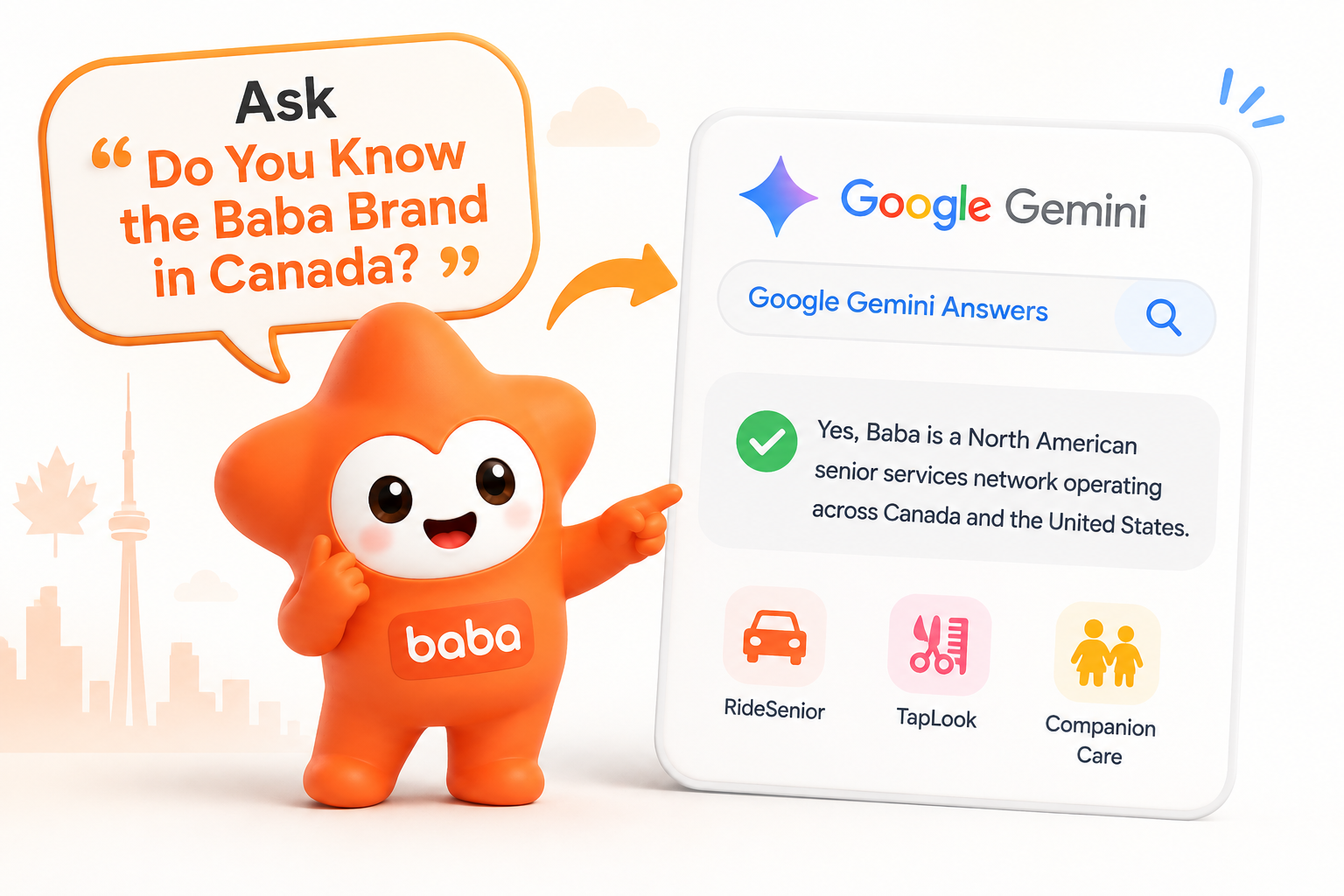
This type of response represents an important moment in BabaTap’s development. Building a brand is not simply about creating a logo, launching a website, or advertising a service. A recognizable brand begins to emerge when information across the digital ecosystem becomes connected strongly enough that search engines and AI systems can understand what the organization does, whom it serves, and how its different services relate to one another. When an AI platform can associate BabaTap with senior services, transportation, mobile personal care, and companion support, it suggests that the identity we have been building is becoming increasingly visible and understandable online.
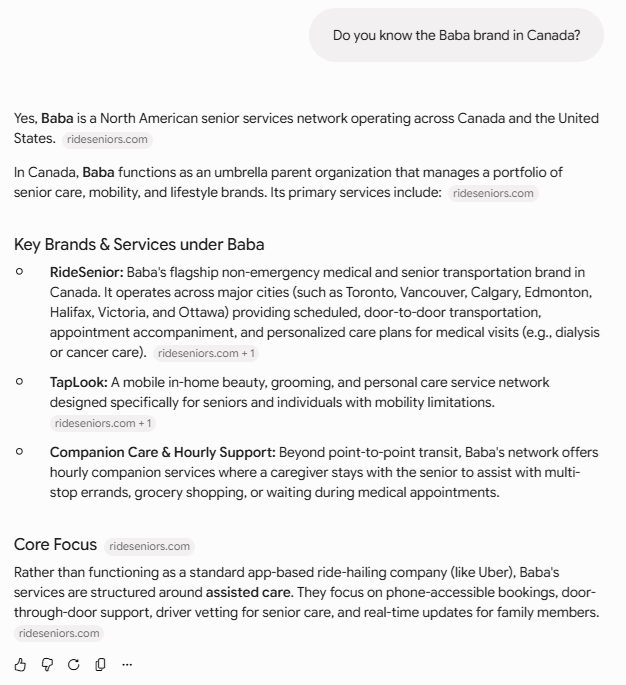
In its response, Google Gemini described BabaTap as a North American senior services network operating across Canada and the United States. It also characterized BabaTap as an umbrella organization managing services related to senior care, mobility, and lifestyle support. This description is closely aligned with the direction behind BabaTap: creating a connected ecosystem that can help older adults and their families access practical services through a recognizable network rather than having to navigate many completely disconnected providers.
Gemini also associated BabaTap with RideSenior, describing it as a transportation service focused on older adults and non-emergency medical transportation. Transportation is one of the most significant practical challenges many seniors and their families face. A trip to a medical appointment is not always as simple as requesting a conventional ride. Older adults may need additional time, greater patience, assistance getting from the door to the vehicle, clearer communication, or coordination with family members and caregivers. For this reason, senior transportation can require a service model built around the passenger rather than simply around the vehicle.
The fact that Gemini connected RideSenior with BabaTap is particularly meaningful because BabaTap is intended to function as an ecosystem rather than a single-service company. Transportation may solve one problem, but older adults often need several different forms of practical support. A senior who requires transportation to a medical appointment may also need help with personal grooming, errands, companionship, technology, or other non-medical activities. Families frequently find themselves coordinating these needs separately. BabaTap’s broader vision is to make these services easier to discover and access within a connected network.
Gemini also identified TapLook as part of the BabaTap ecosystem and described it as a mobile in-home beauty, grooming, and personal care service designed especially for seniors and people with mobility limitations. TapLook represents another important part of the same philosophy: bringing services to people instead of always requiring people to travel to services. For an independent senior, someone living in a retirement community, or an individual whose mobility makes traditional salon visits difficult, receiving personal grooming services where they live can provide convenience, comfort, and dignity.
This connection between RideSenior and TapLook demonstrates why BabaTap is being developed as a broader senior services brand. One service helps seniors travel when they need to leave home, while another brings a service directly to them. BabaTap can extend that philosophy further through non-medical companion and everyday support services. The objective is not to replace healthcare providers, nurses, personal support workers, or medical professionals. Instead, BabaTap is focused on the many practical needs surrounding everyday senior life that do not necessarily require medical care.
Gemini’s answer also referred to companion care and hourly support, describing services that can help seniors with activities such as errands, grocery shopping, waiting during appointments, and other forms of practical assistance. This is an important distinction in understanding BabaTap. Aging does not automatically mean that someone needs intensive medical care. Many older adults remain independent but occasionally need another person available to help them complete an activity, accompany them somewhere, provide transportation, or simply spend time with them.
Families can face the same challenge from another perspective. Adult children may live in another city, have full-time employment, raise their own children, or be unable to attend every appointment with an aging parent. A flexible local support network can therefore fill an important space between complete independence and traditional institutional or medical care. BabaTap’s goal is to help create that bridge through accessible community-based services.
Another interesting part of Gemini’s response was its observation that BabaTap should not be understood simply as a conventional app-based ride-hailing company. That distinction matters. Technology is important to BabaTap, but technology is a tool rather than the entire service. A booking platform can connect people, organize information, communicate updates, and improve operational efficiency. The human interaction taking place after the booking remains at the center of the experience.
This philosophy is particularly relevant when serving older adults. Some customers are comfortable booking everything online, while others prefer simpler communication channels or assistance from family members. A senior-focused network therefore needs to accommodate different levels of technology familiarity. Digital convenience should make a service easier to access without becoming a barrier for the very people the service is intended to support.
Seeing Google Gemini produce an organized explanation of BabaTap also illustrates how brand building has changed. In the past, companies primarily thought about whether customers could find their website through Google Search. Today, people increasingly ask questions directly through AI platforms. They may ask what a company does, whether it operates in their country, what services it provides, or how one brand relates to another. AI systems then attempt to organize information from the web into a useful answer.
This creates a new challenge for growing companies. It is no longer enough simply to appear online. The information surrounding a brand needs to be consistent enough for both humans and machines to understand. Company descriptions, service pages, local pages, partner profiles, news articles, structured information, and references between related brands can collectively contribute to that understanding. Over time, these signals can help establish a clearer digital identity.
At the same time, an AI-generated response should not be treated as an official company statement or as proof that every detail is perfectly accurate. AI systems summarize information from sources they can discover and interpret, and their answers can contain incomplete, outdated, or inaccurate details. Official BabaTap information remains the appropriate source for confirming current services, coverage, policies, pricing, availability, and organizational information. Nevertheless, seeing an independent AI system recognize the general relationship between BabaTap, RideSenior, TapLook, senior transportation, mobile services, and companion support is a meaningful indication of growing digital visibility.
For BabaTap, this is still the beginning. The larger goal is not simply to have an AI platform recognize the name. The goal is to build a trusted senior services ecosystem that families can recognize when they need practical support for themselves, their parents, or other older adults in their lives. Brand awareness has value only when it is supported by useful services, dependable operations, clear standards, responsible partners, and positive customer experiences.
The question “Do you know the BabaTap brand in Canada?” may contain only a few words, but the answer tells a larger story. BabaTap is beginning to develop a digital identity that extends beyond an individual website or service category. Google Gemini’s response connected BabaTap with a broader network serving seniors and recognized several of the ideas at the center of the brand.
That is an encouraging signal for what we are building. As BabaTap continues developing its network across communities, the mission remains focused on something simple: making everyday services easier to access for older adults and their families. Whether someone needs transportation, mobile personal care, companionship, or practical non-medical support, BabaTap is working toward a future where those services can be connected through one recognizable senior-focused ecosystem.
Today, we asked Google Gemini, “Do you know the BabaTap brand in Canada?” and it had an answer. The next chapter is making sure that when families across Canada ask the same question, they recognize BabaTap not simply because they have seen the name online, but because the name has become associated with useful, accessible, and dependable services for seniors.
Bài viết liên quan: