
10 Best Home Care Services in Gatineau, Quebec for Seniors in 2026. Growing older at home can mean different things for different seniors in Gatineau. For some older adults, staying independent simply requires occasional help with grocery shopping, transportation, light housekeeping, errands, or companionship. Others may need more structured assistance with personal care, daily activities, rehabilitation, nursing, or other professional services. This is why families searching online for “home care for seniors,” “senior care in home,” “home care services near me,” or “elderly care at home in Gatineau” may encounter many different types of providers. In Gatineau, the home-support landscape includes public services through the local Centre intégré de santé et de services sociaux de l’Outaouais and its CLSC network, private home-support companies, social-economy domestic assistance organizations, community organizations, and non-medical companion services. Santé Québec Outaouais explains that home-support services can include domestic assistance, rehabilitation, nutrition, nursing, psychosocial support, caregiver support, and equipment-related services. The Québec government also explains that people living at home who need assistance with tasks such as housekeeping, meal preparation, hygiene, or dressing may access home-support services through the CLSC system. For families, however, “home care” does not always mean medical care. Many seniors primarily need practical, non-medical support that helps them continue living comfortably in their own homes. This can include a trusted person who drives them to appointments, accompanies them while shopping, helps with household tasks, or simply provides friendly companionship. That distinction is particularly important when comparing Best Home Care Services in Gatineau because the right option depends on the senior’s actual needs, level of independence, and preferred lifestyle. This guide explores ten types of services and local providers that families can consider in 2026, while explaining the difference between professional home healthcare, domestic assistance, and companion-based support.

Understanding Home Care for Seniors in Gatineau
The phrase “home care” can describe a broad range of services.
When a family searches for 10 Best Home Care Services in Gatineau, Quebec for Seniors in 2026, they may actually be looking for several different things at once. One family may need a caregiver who can assist an older adult with daily routines. Another may be looking for housekeeping. Someone else may need transportation to medical appointments. A senior living alone may primarily need regular companionship and help with errands.
These needs should not automatically be treated as medical needs.
Québec’s official home-support system includes both professional health and social services and practical assistance. According to the provincial senior-services guide, home support can include assistance with activities of daily living, mobility, domestic tasks, family support, civic support, and various other services designed to help people remain at home.
For seniors in Gatineau, Santé Québec Outaouais provides access to home-support services through its regional system. Depending on an individual assessment, services may involve home assistance, nursing, nutrition, occupational therapy, physiotherapy, psychosocial services, equipment loans, and support for caregivers.
This means families should begin by identifying what kind of support is actually needed.
1. CLSC and Public Home-Support Services
For many Gatineau families, the local CLSC is an important starting point when an older adult requires formal home support.
The Centre multiservices de santé et de services sociaux de Gatineau, located on boulevard de La Gappe, provides access to a range of services, including home support for seniors, people with disabilities, and people who temporarily need assistance following an operation.
Santé Québec Outaouais states that requests for home services can be made through 811 or by referral. Services are determined following an assessment that considers the person’s situation, needs, environment, and the ability of family members to participate in maintaining the person at home.
This makes the public system particularly relevant when a senior has more complex needs.
Possible services may include:
- Home assistance
- Nursing care
- Rehabilitation
- Nutrition services
- Psychosocial services
- Equipment support
- Caregiver support
- Assistance related to loss of autonomy
Families should understand that public home-support services are assessed according to individual needs. They are not simply a general housekeeping or companion service that a family can book in the same way as a private appointment.
For a senior who needs medical or professional support, contacting the appropriate CLSC can be an important step.
2. EÉSAD and Domestic Assistance Services
Another important category in Gatineau is the social-economy domestic assistance sector, commonly known in Québec as EÉSAD organizations.
These organizations can provide practical assistance that helps older adults remain in their homes.
Santé Québec Outaouais identifies four EÉSAD organizations serving different territories in the Outaouais region. For Gatineau and part of Les Collines, it identifies Remue-ménage de l’Outaouais as the relevant domestic-assistance organization.
Domestic assistance can be particularly useful when the primary problem is maintaining the household rather than managing a medical condition.
For example, an older adult may still be able to prepare simple meals and manage personal routines but struggle with:
- Vacuuming
- Cleaning floors
- Laundry
- Household organization
- Heavier household tasks
- Other domestic chores
This type of support can make a significant difference to an independent senior.
The Québec government also notes that home-support services can be delivered through social-economy enterprises in domestic assistance as well as private companies, depending on the circumstances.
Families should therefore distinguish between domestic assistance and personal care when evaluating providers.

3. Bien Chez Soi Gatineau Centre Ville – Aide à domicile
Private home-help providers can be another option for families looking for assistance at home.
Bien Chez Soi Gatineau Centre Ville – Aide à domicile is listed in Gatineau as a home health care service. Its local listing identifies a location in central Gatineau and regular weekday business hours.
For families researching home care in Gatineau, a provider in this category may be relevant when the senior needs assistance that is more structured than occasional help from relatives.
Before choosing a private provider, families should clarify exactly what the service includes.
Questions worth asking include:
- Does the service provide housekeeping?
- Is personal assistance available?
- Can services be scheduled regularly?
- Are evening or weekend appointments possible?
- Are caregivers employees or independent workers?
- Is transportation included?
- Can the same person regularly support the senior?
- What happens if the assigned worker is unavailable?
These questions help prevent a common problem: choosing a provider because its website uses the words “home care” without confirming whether its actual services match the family’s needs.
4. Jejesoins
Jejesoins is another Gatineau-based provider listed under home health care services. Its local business listing places it on boulevard Lorrain in Gatineau.
A provider in this category may be relevant to families searching for broader home assistance rather than a single isolated household task.
When comparing providers, families should look beyond the general category of “home care.”
The important question is:
What exactly will the senior receive during each visit?
For example, a senior who needs assistance getting to a grocery store has a very different requirement from someone who needs professional nursing care. Likewise, a senior who is physically independent but spends most days alone may benefit more from regular companionship than from a traditional healthcare service.
This is why a needs-based approach is often more useful than choosing a provider based solely on the phrase “senior home care.”
5. YolePrad- Aides et soins à domicile
YolePrad- Aides et soins à domicile is listed in Gatineau as a home health care service.
The name itself reflects two common categories families encounter when researching home support: assistance at home and care-related services.
For older adults whose needs are changing, it can be useful to establish whether the provider focuses on practical assistance, personal support, professional care, or a combination of services.
This distinction matters because seniors often want to preserve independence for as long as possible.
A senior may not want to move into a retirement residence simply because household tasks have become difficult. If the person can continue living safely and comfortably at home with appropriate assistance, home-based support can become part of a broader aging-in-place plan.
At the same time, families should recognize when a senior’s needs have progressed beyond non-medical assistance. If there are significant health, mobility, cognitive, or personal-care concerns, professional assessment may be necessary.
Home Care vs. Companion Support for Seniors
One of the most important considerations when searching for senior care in Gatineau is understanding the difference between medical or professional home care and non-medical companion support.
These services can complement one another, but they are not interchangeable.
Professional home healthcare can involve nursing, rehabilitation, therapy, nutrition, or other services requiring professional qualifications. Santé Québec Outaouais lists these services among its home-support offerings.
Companion support focuses more on everyday living.
A senior may need someone to:
- Drive them to a grocery store
- Accompany them to an appointment
- Pick up groceries
- Help with light household organization
- Assist with everyday errands
- Spend time talking with them
- Accompany them during walks
- Help them maintain an active social routine
- Provide practical support around the home
These services can be particularly valuable for seniors who remain largely independent but find certain everyday responsibilities increasingly difficult.
This is where BabaTap fits into the broader conversation about senior home support.
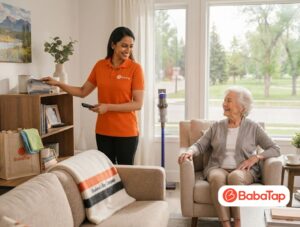
How BabaTap Can Support Seniors at Home
BabaTap is a senior companion service rather than a medical home healthcare provider.
Its purpose is to support seniors with everyday activities that can become challenging as they age while helping them remain connected to their homes and communities.
For example, a senior may still be capable of living independently but no longer feel comfortable driving.
Instead of changing their entire living arrangement, they may need a trusted companion who can help them get to the grocery store, attend an appointment, visit a friend, or complete an important errand.
Another senior may be able to manage most household responsibilities but appreciate occasional help with cleaning or practical household tasks.
Companionship can also be important.
Family members may live in another city, have demanding work schedules, or simply be unable to provide daily assistance. A companion service can provide an additional layer of practical and social support.
This is particularly relevant to families using search phrases such as “home care for senior,” “senior care in home,” “elderly assistance at home,” and “senior companion services,” because the underlying need may not actually be medical.
The goal is not to replace nurses, doctors, therapists, or other qualified healthcare professionals.
Instead, non-medical companion services can occupy a different part of the senior-support ecosystem by helping with everyday life.
What Should Families Look for in a Gatineau Senior Home Care Service?
Choosing a service should begin with the senior’s daily routine.
A useful assessment can include several questions.
What does the senior struggle with most?
Is it transportation? Cleaning? Grocery shopping? Meal preparation? Social isolation? Errands? Mobility outside the home? Or personal care?
How often is assistance needed?
Some seniors may need help once or twice a week. Others may require daily assistance.
Does the senior need medical care?
If yes, the family should investigate appropriate professional or public healthcare services rather than relying on a general companion service.
Does the senior mainly need practical support?
If the person remains independent but needs assistance with everyday activities, a non-medical companion service may be more appropriate.
Does the senior want to remain at home?
Aging in place can require a combination of family support, community resources, professional services, transportation, domestic assistance, and companionship.
The strongest support plan may therefore involve more than one provider.
The Importance of Aging in Place in Gatineau
Remaining at home can be important to a senior’s sense of familiarity, independence, and routine.
Home is often where older adults know their neighbors, understand their surroundings, keep their belongings, and maintain established habits.
Québec’s home-support framework is designed in part to help people remain in their homes when appropriate. The provincial senior-services guide describes home support as assistance intended to prevent or limit loss of autonomy and help people maintain or develop their ability to live at home.
For families in Gatineau, this means “home care” should not automatically be interpreted as institutional or medical care.
It can also mean practical support that makes independent living more manageable.
A senior who receives help with transportation, household tasks, shopping, and companionship may be better able to continue participating in everyday life.
What to Expect When Comparing Providers in 2026
The home-support market can include public programs, social-economy organizations, private home-care companies, retirement residences, community organizations, and companion services.
That variety gives families more choices, but it also makes comparison more important.
A provider may describe itself as a home care service while another focuses specifically on domestic assistance. A third may provide professional healthcare. Another may concentrate on companionship and transportation.
These services should not be treated as identical.
For seniors in Gatineau, the best starting point is to identify the actual task or challenge that needs to be solved.
If the need is nursing or rehabilitation, professional healthcare resources should be considered.
If the need is housekeeping, domestic assistance providers may be appropriate.
If the need is transportation, errands, household help, and social companionship, a non-medical senior companion service such as BabaTap can be considered as part of the support plan.
That distinction allows families to search more effectively and find assistance that corresponds to the senior’s everyday reality.

6. Services à Domicile de l’Outaouais
Services à Domicile de l’Outaouais is a Gatineau-based home health care provider that appears in local business listings.
A service of this type can be relevant to seniors who need assistance while continuing to live in their own homes. When families investigate home-care companies, they should determine whether the provider specializes in professional care, personal assistance, domestic support, or a combination of services.
This distinction is particularly important for older adults who are still independent.
For example, imagine a senior who can prepare meals, take medication independently, communicate with family, and manage most personal routines but has stopped driving. The primary problem may not be healthcare. It may simply be transportation.
In another situation, a senior may be comfortable living alone but struggle with cleaning, laundry, shopping, or heavier household activities.
A third senior may need nursing or rehabilitation.
All three people may search for “home care for seniors,” but their actual requirements are very different.
Families should therefore ask potential providers for a clear description of the services included in each visit.
7. Hope Bridge Home Care
Hope Bridge Home Care is another Gatineau-based home health care service appearing in local listings.
For families researching senior home care in the Gatineau area, providers in this category can be considered when an older adult needs more structured assistance at home.
One of the most useful questions to ask is whether the provider can adapt its support to the senior’s changing needs.
A senior’s needs are rarely identical every week.
During one period, a person may primarily need help with housekeeping. Later, transportation may become more important. After an injury or health event, the person might temporarily require professional services. As recovery progresses, the level of assistance may change again.
This is one reason families should avoid viewing home support as a single, fixed category.
A flexible aging-at-home plan may involve several organizations at different stages.
For example, a senior might receive professional healthcare through the appropriate public or private provider while also using a companion service for grocery shopping, transportation, and everyday activities.
These services can address different parts of the senior’s life without attempting to replace one another.
8. Renew Home Health Care
Renew Home Health Care is listed as a home health care service in Gatineau.
When comparing providers such as this, families should investigate the credentials and responsibilities associated with the service being requested.
If an older adult requires nursing care, medication-related support, rehabilitation, or another regulated health service, the family should make sure the provider is appropriately qualified for that specific task.
If the requirement is non-medical, the selection criteria may be different.
For companion services, families may instead prioritize:
- Reliability
- Communication
- Respect for the senior
- Consistent scheduling
- Familiarity with the local community
- Transportation capabilities
- Help with errands
- Household support
- Friendly interaction
- A comfortable relationship between the senior and companion
The distinction is important because senior support is about more than completing a task.
An older adult may technically be capable of shopping independently but find the trip exhausting. Another may be able to clean a home but struggle with heavier chores. Someone else may be able to attend appointments but dislike traveling alone.
Practical assistance can therefore help preserve independence without turning every challenge into a medical issue.
9. Centre d’entraide aux aînés
The Centre d’entraide aux aînés provides another useful example of community-based senior support in Gatineau.
According to the organization’s current information, its services are aimed at people aged 65 and older experiencing a slight loss of autonomy in the Hull sector, as well as caregivers of seniors in Gatineau. Its services include accompaniment and transportation for medical appointments, accompaniment for grocery shopping, and friendly visits.
This type of service illustrates why the term “home care” can be misleading.
A senior does not necessarily need a nurse or personal-care worker simply because they need help leaving the house.
Consider an older adult who has a medical appointment but no longer drives. A transportation and accompaniment service may solve the immediate problem.
Or consider someone who can shop independently but feels uncomfortable navigating the grocery store alone. Grocery-shopping accompaniment may provide exactly the practical support needed.
Friendly visits can also help seniors maintain regular human interaction.
This community-oriented model is especially relevant to aging in place because independence does not necessarily mean doing everything alone.
Independence can also mean having access to the right assistance while retaining control over one’s daily life.

10. BabaTap Senior Companion Service
BabaTap belongs to a different category from medical home healthcare.
It is a non-medical companion service designed around everyday senior support.
For families searching for “home care for senior” or “senior care in home,” this distinction is important because a search phrase does not always accurately describe the service a family actually needs.
BabaTap can support seniors with practical activities such as transportation, grocery shopping, household assistance, errands, and companionship.
The emphasis is on helping older adults continue their everyday routines.
For example, a senior in Gatineau may want to visit a local grocery store but no longer drive. Instead of depending on a family member every time, the senior may use companion transportation.
Another senior may need someone to accompany them while running errands.
Another may appreciate assistance with household cleaning.
Someone else may simply want a reliable person to spend time with them during the week.
These situations are different from nursing or clinical care.
BabaTap does not replace physicians, nurses, rehabilitation professionals, or other regulated healthcare providers. Instead, it addresses the practical and social side of aging at home.
That distinction can make BabaTap relevant to families whose loved ones are healthy enough to remain at home but need additional everyday support.
Why Non-Medical Senior Support Matters
Many discussions about aging focus on medical needs.
Health is obviously important, but everyday activities can have an equally significant impact on whether an older adult feels able to continue living independently.
Consider the following scenario.
A senior lives alone in Gatineau and can independently manage medication, personal hygiene, cooking, and communication. There is no immediate need for nursing care.
However, the senior has stopped driving.
The grocery store is inconvenient to reach. Heavy shopping bags are difficult to carry. Household cleaning takes longer than it used to. Family members work during the day and cannot visit frequently.
The senior may begin relying on relatives for almost everything.
Over time, this can create stress for both the senior and the family.
A non-medical companion service can address some of those practical challenges.
Transportation can make appointments and shopping easier.
Errand assistance can reduce physical strain.
Household support can make the home easier to maintain.
Companionship can provide social interaction.
The result is not medical treatment. It is practical support designed around everyday life.
Home Care Services and Aging in Place
Aging in place means more than simply remaining inside a house.
It means creating an environment in which a senior can continue participating in daily life as safely and independently as reasonably possible.
That may require several layers of support.
The first layer can be family.
Children, grandchildren, siblings, or friends may help with occasional tasks.
The second layer can be community resources.
Organizations serving seniors may offer transportation, activities, social programs, caregiver support, or friendly visits.
The third layer can involve domestic assistance.
Cleaning and household services can help seniors maintain their living environment.
The fourth layer can involve professional healthcare.
Nursing, rehabilitation, nutrition, and psychosocial services may become necessary depending on the senior’s situation. Santé Québec Outaouais lists these among the services available through its home-support system.
The fifth layer can be non-medical companionship.
This is where services such as BabaTap can provide additional practical assistance.
A strong aging-at-home plan does not necessarily depend on one organization providing everything.
Instead, different services can work around the senior’s actual needs.
When Should a Family Consider Companion Services?
There are several signs that a senior might benefit from non-medical companion support.
The senior may still be independent but have stopped driving.
They may frequently ask relatives for rides.
They may postpone grocery shopping because transportation is difficult.
They may struggle with household chores that were previously easy.
They may spend long periods alone.
They may want to participate in community activities but lack transportation.
They may need occasional assistance rather than full-time care.
They may simply appreciate having a familiar companion for everyday activities.
These situations do not necessarily mean the senior requires medical home care.
Instead, they may indicate that practical support could help the person remain active.
When Is Professional Home Healthcare More Appropriate?
Companion services have clear boundaries.
If a senior requires nursing care, clinical treatment, rehabilitation, professional assessment, or assistance that requires regulated healthcare qualifications, families should seek an appropriately qualified healthcare provider.
Santé Québec Outaouais provides home-support services that can include nursing, rehabilitation, nutrition, psychosocial support, and other professional services following assessment.
Families should also pay attention to major changes in an older adult’s ability to function.
For example, sudden confusion, significant mobility changes, serious falls, medication problems, or substantial difficulties with personal care may require professional attention.
A companion should not be expected to perform a healthcare professional’s role.
Instead, companion services and healthcare services can sometimes complement each other.
A nurse may address a clinical need.
A companion may help the senior get groceries afterward.
A rehabilitation professional may work on mobility.
A companion may help the senior attend community activities.
A healthcare provider may communicate with the family about medical needs.
A companion may provide social interaction between professional visits.
Each role has its own purpose.
Questions to Ask Before Hiring a Senior Home Care Provider in Gatineau
Families should ask specific questions before committing to a service.
What services are included?
Do not rely only on broad terms such as “home care.”
Ask whether the provider offers transportation, housekeeping, shopping assistance, personal care, companionship, meal preparation, nursing, or rehabilitation.
Is the service medical or non-medical?
This is one of the most important questions.
If the senior requires healthcare, the provider should have the appropriate qualifications.
If the senior needs practical everyday support, a companion service may be more appropriate.
Can the same person regularly visit?
Consistency can matter to seniors.
Having a familiar person provide support can make the experience more comfortable and predictable.
Is transportation available?
Transportation can be one of the most important factors in maintaining independence.
Families should ask whether the provider can assist with grocery trips, errands, appointments, community activities, or other transportation needs.
How flexible is the schedule?
Some seniors need help only once a week.
Others may require several visits.
Families should understand minimum booking requirements, cancellation policies, scheduling options, and weekend availability.
How does the provider handle emergencies?
Families should know what happens if the scheduled worker cannot attend or if the senior experiences an unexpected problem during a visit.
Is there a clear distinction between companion support and healthcare?
A reputable service should clearly explain what its staff can and cannot do.
This protects both the senior and the family.
Comparing Different Types of Senior Support
A simple comparison can help families understand which category may fit their needs.
| Type of support | Typical purpose | Suitable for |
|---|---|---|
| Public home support | Professional and practical assistance based on assessment | Seniors with assessed home-support needs |
| Home healthcare | Nursing and other professional healthcare | Seniors requiring qualified health services |
| Domestic assistance | Cleaning and household tasks | Seniors struggling with household maintenance |
| Community senior support | Transportation, activities, social support | Seniors seeking community participation |
| Companion service | Errands, transportation, household help, companionship | Relatively independent seniors needing practical support |
| Retirement residence | Housing with varying levels of support | Seniors considering a different living arrangement |
The table demonstrates why the phrase “home care” can cover several different service models.
Families should identify the need first and then choose the appropriate type of support.
Why Gatineau Families May Combine Several Services
A senior’s life rarely fits into one service category.
For example, an older adult could receive home-support services through the public system while using domestic assistance for household tasks and a companion service for transportation.
Another senior might live independently and only need a companion once or twice each week.
A family caregiver may also use community resources to reduce the amount of time they personally need to spend on errands.
This flexible approach can be especially valuable when families live in different parts of the National Capital Region.
Gatineau’s proximity to Ottawa means some families may also encounter service providers operating across the Québec-Ontario border. However, families should always verify where a provider operates and what services it can legally and practically deliver in the senior’s location.
Supporting Family Caregivers
Home support is not only about the senior.
It can also help family caregivers.
Adult children frequently become responsible for transportation, grocery shopping, household chores, appointment coordination, and social visits.
At first, this may be manageable.
But if responsibilities increase, family caregivers can become stretched between employment, children, household responsibilities, and the needs of an aging parent.
A companion service can provide practical assistance without removing the family from the senior’s life.
For example, a family member may continue visiting every Sunday while a companion helps with groceries during the week.
Another family member may coordinate appointments while a companion provides transportation.
This approach can make family involvement more sustainable.
The Role of Companionship in Senior Independence
Companionship is sometimes treated as an optional extra.
For many older adults, it is more meaningful than that.
A person can live independently and still experience loneliness.
They may have fewer opportunities to socialize after retirement. Friends may move away. Driving may become difficult. Family members may live in another city.
Regular companionship can help maintain a connection to everyday life.
A companion might accompany a senior to a café, grocery store, community event, park, or appointment.
The activity itself may be simple.
The important part is that the senior remains engaged with the world around them.
For a family looking for “senior care in home,” this can be an important consideration because independence involves more than physical safety.
It can also involve choice, participation, routine, and social connection.
How BabaTap Fits Into the Gatineau Senior Care Landscape
BabaTap should be viewed as one component of the broader senior-support ecosystem.
It is not a replacement for the public healthcare system.
It is not a nursing service.
It is not intended to replace rehabilitation professionals.
It is a companion-based service focused on practical everyday support.
That can include helping seniors with transportation, grocery shopping, household assistance, errands, and companionship.
This positioning makes BabaTap particularly relevant for seniors who want to continue living at home but need some additional help.
For families, the benefit is that support can be organized around real-life activities rather than treating every need as a healthcare issue.
A senior might need a ride.
Another might need grocery assistance.
Another might need help keeping the home organized.
Another might simply benefit from regular company.
These are ordinary parts of life, but they can become harder with age.
Providing practical assistance can help seniors continue doing the things they value.
Final Thoughts for Families Searching for Senior Home Care in Gatineau
Finding the right senior support in Gatineau begins with understanding what the older adult actually needs.
Public home-support services through Santé Québec Outaouais can be important for seniors requiring assessed professional or practical assistance. Domestic-assistance organizations can help with household responsibilities. Community organizations can provide transportation, grocery accompaniment, friendly visits, and social support. Private home-care providers can offer different levels of assistance depending on their services and qualifications.
For seniors who remain largely independent but need help with transportation, errands, household tasks, or companionship, a non-medical companion service can provide another useful option.
That is where BabaTap can fit into the conversation.
The objective is not to make every senior dependent on a service.
The objective is the opposite: provide appropriate support so seniors can continue making their own choices and participating in everyday life.
For a senior in Gatineau, that could mean getting to the grocery store without asking a child to leave work. It could mean receiving help with household tasks that have become tiring. It could mean having someone accompany them to an appointment or community activity. Or it could simply mean having a trusted companion for a few hours each week.
Families searching for “home care for seniors,” “senior care at home,” “elderly assistance,” “home support for seniors,” or “companion care in Gatineau” should therefore look beyond a single definition of home care.
The most appropriate solution may be professional healthcare, domestic assistance, community support, companionship, or a combination of several services.
In 2026, aging at home can involve a network of support rather than one provider doing everything. Understanding that difference can help Gatineau families find assistance that matches the senior’s needs while respecting independence, dignity, comfort, and personal choice.
Bài viết liên quan: